Showing posts with label Our little red dot. Show all posts

Wednesday, October 08, 2008

I don’t support Singapore's F1 night race


Recently Singapore hosted the world’s first night Formula One Grand Prix. Many of my friends were so excited about it. I am happy that they had a good time.

The event was hailed as a big success and everybody, including our prime minister was ecstatic that Singapore not only got itself noticed by millions of television viewers worldwide, but had our reputation as a super-efficient city confirmed by many visitors who rightly proclaimed that “only Singapore could have pulled this off.”

Personally, I don’t support the F1 and did not even watch the race on TV. Somehow in this age of universal distress over global warming and dwindling energy resources, I find it difficult to get excited over a bunch of petrol-guzzling machines speeding round and round an arena lit up by artificial lights till “it was like day”, and getting nowhere.

But I did not want to be a spoilsport and thus chose to blog about it after the event is long over.


** CC Photo byFlickr member bernardoh

Saturday, December 29, 2007

Law breakers abound in the Fine City


Creative Commons image from synnwang.
Creative Commons image from magnusvk

The world generally thinks all Singaporeans are law-abiding people who would not even cross a deserted road junction before the ‘green man’ appears. But we Singaporeans know better don’t we? From littering to speeding, from illegal parking to soliciting, from buying illegal 4D to feeding monkeys, we live by the army motto; You can do anything; just don’t get caught. This would explain our sudden change of behaviour whenever we cross the causeway into Malaysia (aka Bolehland), where shall we say, the authorities are more tolerant of litter bugs and speedsters.

But back to the tiny red dot. Caught, we seldom are. Everyday you find people writing to the forum pages of our local newspapers lamenting the widespread flouting of our laws. And each time the relevant authority will come back with the standard reply. Oh we take a serious stand against this problem. Last year our enforcement officers issued summons to X thousand offenders. We seek the public’s cooperation to stem out this problem. If you see anyone committing this offence, please call this number.

And the problem persists.

The only time you see some real action from the authorities is when one of the following three things happen.

1) A tragedy occurs and lots of unpleasant publicity is generated.


2) The newspaper reporters take pity on us and decide to do a huge coverage of the problem. The recent reporting about touting by taxi-drivers is a good example.


3) Some big-shot minister complains. Remember how they decided to ban chewing gum because S. Dhanabalan remarked that people who chewed gum looked like cows. (OK lah, I exaggerate a little, but you know what I mean right?)

Let’s take the latest farce for example. Today’s Straits Times carried a big report of a pregnant lady whose plastic bag got snatched by some monkeys at the MacRitchie Reservoir. Much of the blame goes to those baboons who cannot resist feeding their cousins. We see them every time at the reservoir parks. I went to Upper Pierce Reservoir on Christmas day and saw several cars stopped by the roadside and the occupants happily feeding monkeys despite the huge signs threatening a fine of $250 dollars. From the look of it, I think some of those folks went to the park for the specific purpose of feeding the monkeys. And it was a family affair too.

As expected, in the Straits Times report, the Nparks (National Parks Board) appealed to the public to report such offenders if they came across them – as if it was such a rare occurrence. Exactly the same thing happened some months ago with the problem of drivers who left their engines running in the car parks. It appears the traffic police (or should that be the NEA?) did not know that any day of the week, if you go to a multi-storey car park in the HDB heartlands during mid-day, you are sure to see taxi-drivers and truck drivers snoozing away with their car engines and air-cons running.

Anyway, now that the issue has been blown up by the press, the authorities will spring into action over the next few weeks and then guess what will happen? Everything will just go back to the ‘normal’.

I think there are three possible explanations for this strange phenomenon in our country. It could mean that our population is growing too fast and the authorities simply do not have the manpower to cope. Or the ever ‘ting hua’ ( 听话or obedient) Singaporeans are heeding our dear leaders’ exhortation to be more ready to take risks. But I think it’s probably because Singaporeans are getting too rich, and a few hundred dollars is ‘peanuts’ to them - and some have so much peanuts that they simply have to share it with their cousins.

Saturday, November 17, 2007

Our foreign talent policy is short-sighted

The front page of Weekend Today (17 November 2007) carried two headlines.

1) “Cracks in society are showing” – SM Goh raises concern as foreign talent stats hit new high.

2) “If only they were given the time”


Interestingly, I find that the second headline provides the answer to the issue raised in headline number 1.

In the first article, Senior Minister Goh Chok Tong basically points out the problem that with the rapid influx of foreigners into Singapore, many of them are finding it hard to assimilate into Singapore society. I was not surprised. Are you?

It is common sense really. How can you expect people to adapt so quickly to a new society. The mainland Chinese may look like Singapore Chinese (and likewise the Indians) but he is more different from us that a local Indian or Malay culturally. I think you need years to achieve this kind of adaptation. Let me give you two personal examples.

Recently I received a marketing call from a lady who was obviously a mainland Chinese. She was trying to sell some services related to property. She asked if I could understand Chinese; and I answered yes. Then she launched into her sales pitch. But she was speaking so quickly and coupled with her mainland Chinese accent, I had difficulty following her. I asked her to slow down and she did … for a while; and then she reverted to her incomprehensible rapid-fire Chinese. In the end, I simply gave up.

On the other hand, I had an opportunity to meet a classmate of my son, an 18-year old China scholar who had been studying in Singapore for about four years. I had little difficulty communicating with him. His English, though a little different from ours, was perfectly comprehensible.

These two encounters with mainland Chinese clearly shows how difficult it is to make adjustment in just one area – the way we speak; and I am not even talking about learning a new language. This is particularly true for the adults. The bottom line is that they need more time. In the light of this, I wonder, is it wise to bring in foreign talents into our country in such huge numbers?

My own conclusion is that our government’s foreign talent policy is short-sighted. Our economy is growing and our population growth is too slow. Answer? Bring in more foreigners lor.

On paper, it looks impressive. We are forward-looking. We anticipate problems before they arise. We act fast and grab the talents before the other developed countries do so. But I think it is short-sighted because it is basically a quick-fix solution which brings with it many long term consequences; some of which like the one mentioned by SM Goh, are quite predictable. There are probably many others. For example, our recent spats with the China-born athletes have also raised another problem related to their commitment to our country.

I think we should really re-look at our foreign talent policy. For a start, take a look at the problems faced by other societies that have adopted a similar policy; for example the UK and US. Are there lessons for us there?

We should also re-look at our assumptions. Just because they are from China and India, and we have a large Chinese and Indian population does not mean that they are like us. Singaporeans are very ‘westernised’. Our Chinese have been labeled as ‘bananas’ by the Taiwanese and mainland Chinese – yellow on the outside but white on the inside. Looks can be deceiving.

Tuesday, November 13, 2007

Be discerning when you donate

In Singapore, we have no shortage of charity organizations. Some are huge and employ aggressive marketing techniques to appeal to your emotions. They hire famous artistes to perform daring stunts on TV and make moving appeals. The Ren Ci Hospital & Medicare Centre even has its CEO - a monk no less doing Fear Factor style dare-devil stunts like standing an 8x8 inch platform on top of a wobbly metal structure erected 5 stories high in Suntec City for 1 hour 45 minutes and 28 seconds.

And kind but gullible Singaporean fall for these stunts hook, line and sinker. They must feel really stupid that hot on the footsteps of the National Kidney Foundation saga, we have another scandal in the making. If you have been donating to Ren Ci, please ponder over this.

- Ren Ci has been making interest-free loans totaling millions of dollars to various companies from as far back as 1996. Apparently, these organizations are linked to the CEO. Is that how you want your hard-earned dollars to be used?

- $200,000 to $300,000 remains to be accounted for at the multimillion-dollar charity. Is that where you want your hard-earned dollars to end up?

I don’t know about you. But I smell another NKF-type stinker brewing?

I think we should all learn a lesson from this latest fiasco, if we have not already done so from the previous one. We just have to be more discerning. Don’t be lazy. Do a bit of homework before you sign that cheque. Even if the amount is not big, it is irresponsible to use you money so foolishly. You are depriving other more deserving charitable oranisations of your precious dollar. They are many small and low profile charitable organisations that do their work quietly and without much fanfare. Find out who they are and consider is it more worthwhile to give to them instead.

The same advice applies to those show biz personnel who work so hard to help raise money for these charities.

Tuesday, October 23, 2007

The Singapore frog is almost cooked already

Nominated MP, Professor Thio Li-Ann was wrong when she said in parliament yesterday that “repealing Section 377A is the first step of a radical, political agenda which will subvert social morality, the common good and undermine our liberties”.

That first step was taken long ago when:

1) They legalized abortion.


2) We gave in to the loud spoken minority and liberalized our censorship laws. The film rating system in our country is a joke. Pornography is disguised as ‘artistic’ entertainment and shown in our third-rate cinemas. Children in school uniform openly rent NC16 and M18 videos from our shops.

2) We made the decision to build casinos in this country after standing firm for 40 years.

3) Our dear leaders openly promised that 377A will not be enforced. Dr Stuart Koe, the gay activist was right when he said, “To have a law that they articulate they are not going to enforce really brings the law into disrepute.”

Have you heard of the ‘boiled frog syndrome’? It is said that if a frog is placed in boiling water, it will jump out, but if it is placed in cold water that is slowly heated, it will never jump out. Such a frog can be boiled alive without knowing it.


In our case, the frog is almost cooked already.

Friday, August 10, 2007

Singapore Boleh

It’s National Day season and I keep seeing this new phrase in the papers; Singapore – The City of Possibilities.

Haha. So not only Malaysia Boleh, Singapore pun Boleh!

But, if one were to adopt a pessimistic view, there are all kinds of disastrous possibilities; like ...

Singapore: The Vice Capital or The Sardines City etc. etc.

Saturday, June 16, 2007

A Tale of Slavery in 2 Cities

I read not one, but two reports of modern-day slavery in TODAY this morning.

The first was about a slavery ring in China in which more than 1,000 people were forced to work in brutal conditions. More than 450 young men and children had been rescued from a string of brick factories in Henan and Shanxi provinces. Some of the children were as young as eight. Many had injuries sustained at the hands of their cruel bosses. One man in his fifties was even beaten to death with a shovel for ‘not working hard enough’.

Many of the children had been abducted from streets and sold for as little as 500 yuan (S$101) to factories and mines where they were starved and forced to work long hours under appalling conditions, with dogs ensuring they could not escape.

The second report was about slavery right here in Singapore! In a story titled, The Story of Workhorse Albert’s Life or Lack of One, Murali Sharma wrote that “unsatisfactory work conditions are quite widespread”. His good friend Albert is a typical example of a victim of Singaporean-style slavery. He had to slog from 8.00 am to 10.00 pm on most days. His boss is a slave driver who doesn’t trust him and wants him to be contactable even on Sundays, and often berates him for his own mistakes. The poor chap is so miserable and stressed that he cannot even perform what in Singapore is considered a patriotic duty - marrying and procreating.

There is a slight difference in Albert’s case of course. He earns a 5-figure salary; and if he were to try to escape, he is unlikely to beaten or bitten.

Tuesday, June 05, 2007

Was That Really Necessary?

By now, if you do not know that Mediacorp artiste, Christopher Lee has been jailed for drink driving, you must be a hermit. And if you previously did not know who he was, you certainly do now. His face has been splashed all over the newspapers. The Straits Times even had one half of the front page of its Sunday Lifestyle Section covered with his photos.


Come on. I know the public has a right to know. And newspapers have a duty to report. But half a page? Now was that really necessary? The man is already paying a heavy price for his mistake. Is it really necessary to shame him further in this way?

Monday, May 21, 2007

Must it always be about Money?

The Singapore daily, TODAY has this tagline: We set you thinking. A couple of things I read this morning set me thinking.

In a report about Michael Moore’s latest movie, Sicko, the director, famous for movies like Fahrenheit 911 and Bowling for Columbine, was quoted as saying that he was trying to ask questions like, “Why do we behave the way we behave? What has become of us? Where is our soul?”

This reminded me about something former Malaysian prime minister, Dr Mahathir said recently about us; “Singapore believes the most important thing is what profits Singapore”.

Offhand, I would like to dismiss this as another of his thoughtless, unsubstantiated accusations. But if you think about it objectively, there may be some truth in what he said. A lot of times, our behaviour gives others the impression that profit is our only criterion for evaluating decisions in practically every aspect of our lives.


Let’s take the example of our sales people and businessmen. You must have encountered such a situation before. You walk into a shop and the salesman is all smiles and enthusiastically answers your questions. But the moment it becomes apparent that you are not going to buy anything, his attitude changes, and he makes no effort to hide his irritation and wish that you would leave and stop wasting his time.

Not long ago, we had a huge debate in this country about the decision to build casinos after decades to saying no. In parliament, speaker after speaker spoke about the ills of having casinos; but in the end they were persuaded because of the prospect of revenues and jobs. We will come up with lots of measures to reduce the social impact of gambling on our society. But what about the harm that it does to foreigners who we will woo to come here to gamble? Not our problem? Then Mahathir is right isn’t he?

For years, the Indonesians have been pressurizing us to sign an extradition treaty so that they can go after corrupt officials who hide their ill-gotten wealth in Singapore. We have always resisted because it will affect our reputation as a financial capital. We will only sign the treaty if there are other conditions attached to it and bring benefits in other areas. But, what about the fact that we have helping dishonest people to get away with their crimes? Again, not our problem?

Last Saturday’s edition of Today carried this headline, What Price the Pink Dollar? It reported on the results of a poll commissioned by Today which showed that a majority of Singaporean heartlanders were against making homosexuality legal in Singapore. The article went on to argue that this was not good for Singapore. A law criminalizing homosexuality will work against our push to lure foreign talent here and grow an ideas-driven, creative economy because homosexuals are supposed to be creative people. We do not want to be seen as a ‘culturally intolerant and sterile’ people. But what about the long term effects of welcoming such ‘alternative lifestyles’ on our society?

Why do we behave this way? I don’t know. Maybe it has to do with the fact that our leaders are all paid ‘market rates’ and constitute some of the best brains that money can buy in this land.

Thursday, May 10, 2007

Simplicity

Did you see this article in Today?


It's about the GMP Group which does not require it's job applicants to fill up a lengthy application form. They believed that a simple cover letter and resume are “more than enough”.

It reminded me of a book by Edward De Bono entitled simply, SIMPLICITY. In it, he lamented that many procedures in this world are far too complicated. He cited the example of those irritating Embarkation Forms that we have to fill up each time we visited a foreign country. By the way, he wrote this book before September 11. He questioned why some countries (I think he quoted France as an example) only required a simple 4 or 5 - question form whilst most others have literally pages of questions to answer.

I am tempted to ask the same question about job application forms here in Singapore. If GMP can do with a simple resume and cover letter, why do most organizations require you to fill up lengthy forms. Out of curiosity, I visited the websites of some large organizations in Singapore. Most of them asked the customary questions like which schools you attended, your children’s date of births etc. Some like the NTUC, a supposed champion of older workers' rights, even asked for your grades in your O level exams. I pity guys like my 56-year old friend, who was retrenched 2 years ago. He will have to submit information about his grades from nearly 4 decades ago. Quite possibly, the primary school he attended may not even exist today.

A screen shot showing just a part of NTUC's online application form.
We should thank TODAY for this article. Let’s hope that more employers, especially our largest employer, the government, will follow GMP’s example and change their procedures rather than waste their energy to try and ‘fix things that ain’t broke”.

Thursday, February 15, 2007

Does Customer Service Training Work?

In today’s edition of TODAY (the newspaper), there’s an article on customer service. I believe it is part of a regular column by Liang Dingzi called Serve Us Right.

In today’s story, the writer narrated two cases of poor customer service. The first was from a hotel and the second, from a bank. From the first she concluded with this cardinal rule of customer service; “When in doubt, decide in the customer’s favour“, and from the second; “Never make an issue of doing the customer a favour“.

This article got me pondering. Certainly in the hotel and banking industry, the frontline staff have gone through extensive training in customer service. So whilst the article makes interesting reading for a layman like me, it wouldn’t be teaching those people to whom her story is directed anything they don’t already know.

I am reminded of an interesting post by a blogger called Victor who narrated his somewhat unpleasant encounter with a bank officer at a reputable bank. He then contrasted this with a much happier encounter with a hawker. Comparing these two service providers, the former, the bank officer is probably much better educated and have attended numerous hours of customer service training. Yet, in the words of this blogger, “JY (the bank officer), looks like you could learn something from Helen, the coffee lady. She only sold me a cup of tea that cost a mere 60 cents and yet she took pride in providing good service. On the other hand, you know that my dealings with your bank run into several hundred thousand dollars and are worth several thousand dollars in annual earnings to your bank, part of which pays your salary.”

So what conclusion can we draw from these two articles? My own conclusion is that what we have here is not a problem of knowledge or skill. What we have is what my children like to call, AP, or Attitude Problem.

Can such an attitude problem be addressed by sending the staff for more customer service training? I very much doubt so. Unlike lack of knowledge or skill, poor attitude is much more complex a problem, and its causes don’t always lie with the individual. It is influenced by a variety of factors like work environment and culture, staff relations, staff welfare, work overload and so on, and often points back to the individual’s boss. Hence, the boss who simply sends his staff for training without taking a good hard look at himself, is like the man who lost a coin in a dark alley and searched for it under a lamp post.


And the results are all around for us to see.

Related posts:
1) Interesting Encounters with Rude Cashiers
2) Consciously Rude

Tuesday, January 09, 2007

The Great Massacre Continues

Since I last wrote about this great human tragedy in Singapore and India, the killing continues unabated.


In a recent report in the Singapore Straits Times, it was reported that 7,000 girls are aborted EACH DAY in India. While I suspect that this figure may have been exaggerated, because a search on Google has shown varying numbers, one can still safely assume that the true figure is staggering. In comparison, our own figure of only 14,000 a year in Singapore, which covers both sexes, may even appear trivial.

While you are patting yourself on the back, your might as well take some pride that in our highly advanced society, the operations are carried efficiently and safely in clean, modern and comfortable surroundings. No backstreet abortions in our squeaky clean country – you can be sure of that. Just do a search on the internet and take a look for yourself at some of the advertisements for abortion services complete with diagrams and photos and user-friendly explanation. Not only are you assured of GEMS (Going the Extra Mile Service) service, you can even use your Medisave money to offset part of the fee so that you hardly feel the pinch.

So whether you are young or old, no need to wait for the next Romancing Singapore campaign to come around. Just go ahead and do your thing. No need to worry about this irritating thing that may come along. Just pop into one of our many ‘fertility clinics’ and they will help you to get rid of it in a jiffy and nobody need shed a tear.

Saturday, December 02, 2006

So Many Outreached Hands

In Singapore, practically everyday, everywhere you will encounter an outreached hand asking for your donations. Let’s start with your home. Every week I receive letters from charities like the Red Cross, Salvation Army, Christian Outreach To the Handicapped, Association of Mouth And Foot Painting Artists' just to name a few. Some come to your doorstep, and others, right into your living room via the television. And when you step out of the house, they accost you at MRT stations and kopitiams.

After a while, you develop compassion fatigue and you learn to say 'no'; especially when you worry that the organisation you donate to will turn out to be another NKF. Recently, I received a request to donate to the National University of Singapore. Like many other Singaporeans I refused. I don’t know. Looking at all the beautiful stadiums and concert halls they have, I just don’t think they need my dollar more than the many small, lesser known charities.

But there's one particular outreached hand (maybe I should say fist) that you cannot say no to. I am talking about our government of course. Shortly, they intend to increase the GST or Goods and Services Tax by 2% to 7%. Apparently our government needs the money to fund various programmes to help the aged and the needy. But they are so kind. They promise not to increase fees for government services for one year. Does that mean that yearly increases are a norm? Anyway, after the one year they can always make up for it can’t they?
.
Sometimes, I wonder. If we are as well off as everybody seems to believe, how come there are so many poor and needy people in this little country?

Thursday, September 07, 2006

Another World No. 1


Hurrah! We have achieved yet another World No. 1.


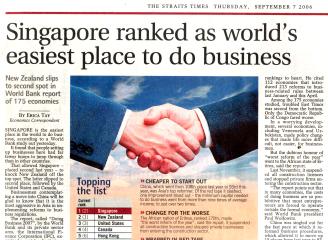
A report in today's Straits Times reads:

“Singapore is the easiest plaice in the world to do business, according to a World Bank study out yesterday.

It found that people setting up businesses here had far fewer hoops to jump through than in other countries.

That allowed Singapore – placed second last year – to knock New Zealand off the top spot.”


Now isn’t that a cause for celebration. But before you bring out the champagne, may I ask you to consider one other piece of news which I heard on Radio 938 Live yesterday evening.

A cleaner, who earns only about $600 or $800 a month, is being sued by Singtel for chalking up thousands of dollar of mobile phone bills (plus legal fees). Apparently, in our country, it’s not only easy to set up a business; it is also a breeze to open a mobile phone account. All you need is a letter of authorization and a photo-copy of your identity card. So the cleaner’s supervisor, claiming to be her son, was able to open several broadband internet and mobile phone accounts with different telcos; and chalked up thousands of dollars of bills. He has since disappeared and the police are unable to trace him.

I estimate that this poor lady, a divorcee with 2 sons, will have to slog to her dying day to settle her bills.

Okay, now you can bring out the champagne.

** By the way, setting up a company is easy here, but wait till you try to close it.

Sunday, February 12, 2006

Majority of Singaporeans Support Death Penalty

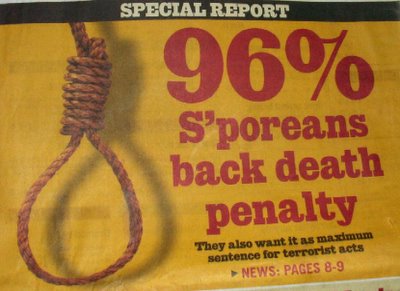
After reading my earlier post about the Biblical Stand on Death Penalty, Mr Wang expressed his amazement that the bible actually prescribes the death penalty (for murder). I suspect that he will be even more amazed when he reads today’s Sunday Times which reported that, according to a survey of 425 Singaporeans and permanent residents, 96% actually supported the death penalty.

Almost everyone here, both young and old and of every race and education level, supports the death penalty for heinous crimes, a survey shows”, read the opening paragraph.


Frankly, I too was surprised. I would have guessed that the figure would not exceed 60 to 70%. Even more shocking was that many of these guys were even more bloodthirsty than me. For example, nearly half (45% and 42% respectively) actually advocated the death penalty for sex with children under the age of 12 and rape. I only support the death penalty for murder and nothing else. In fact I think we are too liberal in the use of the rotan.

One conclusion I can draw from this survey is that the blogosphere is not a good place to gauge public opinion. From most of the blogs I have read regarding this issue, one would have thought that the majority of Singaporeans are opposed to the death penalty.

I guess this is bad news for the opposition parties. They appeared to be quite hopeful that the criticisms of government so widely and vociferously expressed in Singapore blogs were reflective of the general feeling of Singaporeans towards the PAP government. I really think they should not get their hopes too high.

As for me; sigh – it is not going to make any difference. I didn’t get to exercise my vote for the past few elections (lost count already) and I doubt it is going to be different this time.

Wednesday, November 02, 2005

Consciously Rude

I once attended a seminar on Safety. The speaker talked about 4 levels of safety behaviour. It goes something like this:
  • Level 1: Unconciously unsafe - this person is not even aware that he is behaving in an unsafe manner.
  • Level 2: Consciously unsafe - this person has probably undergone safety training, and is aware that he is behaving in an unsafe manner.
  • Level 3: Consciously safe - this person has probably undergone safety training too, and consciously reminds himself to adopt safe work practices.
  • Level 4: Unconciously safe - after prolonged practice, safety becomes a part of this person's habits and he adopts safe practices unconsciously (e.g. Sporeans buckling up whenever they get into a car).

I believe we can apply this concept to customer service by replacing the words, 'safe' and 'unsafe' with the words, 'courteous' and 'rude'.

I think many small Singaporean establishments like the HDB retail shops and hawker stalls belong to the Levels 2 and 3. Previously they mostly belonged to Level 1. But the bad economy and tough competition caused them to 'shape up or ship out'.

The other day, I bought some fruits at an HDB shop in North Buona Vista. As the lady started to count the apples that I have selected and pack them into a plastic bag, she suddently put one aside and told me curtly to take another. As my hearing was not so good, I asked her to repeat.

"Go and take another apple", she ordered somewhat impatiently. "This one is bad."

After I returned with a new apple, she toned down her voice considerably to explain that one of the apples I had chosen earlier was slightly rotten. (She was probably thinking. "This chap is not only deaf, he is blind as well.") It wasn't exactly an apology, but she must have realised that she shouldn't have adopted such a rude tone of voice with her customer.

I cannot comment about the situation in expensive establishments because I seldom patronise such places. But, I suspect mostly they are in Level 3. With the strong emphasis on customer service training, many sales staff do make an attempt to be courteous. But it is tough for them because it goes against their nature.

I am sorry to say this; but I think that Singaporeans generally are quite rude and impatient. I hope many people will disagree with me.

Saturday, August 27, 2005

Our Courts Not Supporting the PM

Our PM wants to do more for old people and improve the level of customer service in Spore. But judging from today's reports on the Took Leng How/Huang Na murder trial, the courts are not very supportive leh.

Firstly, those poor retirees had to queue for hours to get into the courtroom only to find that there were not enough seats. And then those in the gallery could not even see the star, sorry, I mean the accused. Worse of all, the verdict took only 3 minutes to deliver. Even the accused's family were not cooperative - no hysterical sobbing or fainting.

Understandbly, those poor old folks were so disappointed. No wonder one woman complained to the reporters. One chap even vented his frustrations on Took's wife.

Tuesday, August 16, 2005

Interesting Encounters With Rude Cashiers

Recently there were some articles in Today lamenting the low standard of customer service in Singapore. Actually, I find that the level of courtesy amongst the heartland retail shops and hawker stalls has improved considerably these past couple of years. This is probably due to the tough business environment and intense competition. Nevertheless, it is still quite common to encounter rude sales staff. Here are a couple of interesting encounters.

Encounter no. 1: Cake Shop at Bishan North Block 282

(Sorry this happened a few months ago, and so I cannot recall the exact figures)

I selected $5.60 worth of buns and paid the cashier $7; one $5 and one $2 bill. She then returned me $2.40 mostly in coins. As I turned away and counted the change, I turned back to point out her mistake. But to be doubly sure, I re-counted and then asked her how much was my purchase.


She replied impatiently: “Total is $5.60. You gave $7 and so I return you $2.40 lor ." .…. (pause) .. "Oh sorry, I keep thinking it is $8”, she added as she sheepishly she took a $1 coin from my palm.


Encounter no. 2: Food Court at Yung Ho Road (opp NTUC Lifestyle Centre)

The Cantonese have saying; “sin king loy yi, hou king yan”; meaning to judge a person by the way he or she dresses. This was often used to describe the discriminatory service meted out by rude Hong Kong sales people (in the bad old days that is – heard that they have much improved in recent years).

Recently I encountered discrimination of a slightly different sort. I was on my way to Jurong with 2 colleagues to meet a client, and was dressed relatively formal in long sleeves shirt and tie. As we were early, we decided to stop for coffee. I went up to the cashier to place my order. “2 coffees and 1 tea please”. But she was busy taking stock of cigarettes and totally ignored me. I was undecided whether or not to repeat my order. Maybe she already heard my order and she might scold me for being impatient and disturbing her. Or maybe she did not hear? Fortunately, her colleague came along and attended to me. Just then, along came a young man dressed in factory clothes and placed a similar order. Guess what .. our rude cashier girl immediately responded to him is such a friendly tone.

I never knew that you can be discriminated against for dressing smart.

On the other hand, it may have nothing to do with attire at all. Maybe it is a case for middle-aged uncle vs young Ah Beng – the choice is clear right? Anyway, it is still discrimination.

Wednesday, August 10, 2005

Extension of Smoking Ban

The government has announced the decision to extend the smoking ban to coffee shops. Although I am a non-smoker, I am against this measure.

1) It will affect the business of coffee shops. Business these days is already so tough for the poor chaps.


2) It is rather unfair to the smokers. If smoking is so bad then you should ban it outright. If you choose not to ban it, then you should at least let these guys (who are already paying so much taxes) to have some places to enjoy their fixes.

3) Coffee shops are supposed to set aside the open-air areas for the smokers. In our hot climate, that is in fact the best place. Whenever, I eat out with my family to at coffee shops, we like to sit there.

4) I noticed that many smokers have the nasty habit of flicking their ashes onto the floor and then discarding the butt (again on the floor) and stepping on it. I have even seen well-dressed young ladies do that. Now if these people are forced to take their smoking to the void decks, wouldn’t that add to the littering problem – which NEA is already finding it tough to contain.

5) Last but not least, I think this is another one of those laws that simply cannot enforced; (like the “flush after use or you get fined” law). In any case, as one of our ministers pointed out in parliament last year during the 'great casino debate', Singaporeans are matured enough to decide what is right and wrong. So they don't need more regulations to tell them what they should and should not do.

Saturday, May 28, 2005

The Great Singapore Massacre


The Great Singapore Sale just started today. But I wonder how many of my fellow Singaporeans are aware that the Great Singapore Massacre has started long ago.

According to the Singapore Obstetrics and Gynaecology Society, 14,000 abortions were carried out last year. President of the society, Dr Lee Keen Whye was reported to be disappointed that the number of tertiary-educated women going for abortions has tripled in the last 16 years. Doctors say it is shocking that abortion rates among tertiary-educated married women in Singapore are still high, since educated women are supposed to comprehend the importance of family planning. They think that more education on family planning methods is required.

I believe that this will not work because the real issue is not about ignorance but about values.


As long as our society, and that includes men and government leaders, do not believe that a fetus is a living human being that can breathe and feel pain, and that abortion is equivalent to killing, things will not improve. As long as we tell ourselves that, since we cannot see the baby inside a woman’s womb, we cannot hear it crying, then it is not alive and can be disposed of as and when we want, then things will not improve.

Yes, education is required; but it should be education on the real facts of life; for both men and women. I urge all readers of this post to go to the following website and find out the facts for yourself:
www.justthefacts.org


If you knew the facts, then you will not be like those readers who wrote to the press after last Tuesday’s news article. Instead of grieving for the loss of precious lives, they bemoan the “waste” of babies because our country is facing a population decline.

If more Singaporeans knew the facts, then maybe in addition to the tears that they shed at the passing of our former president and the pope, they will shed a tear or two for those 14,000 unknown, unnamed babies who died last year. Both Dr Wee and Pope John Paul lived to their eighties; but I wonder how many of the 14,000 lived up to 80 days.

If more Singaporeans knew the facts, then maybe we as a society will feel some shame for the fact that our country has one of the most liberal abortion laws in the world.

I know from my visits to many Singaporean blogsites that most young Singaporeans value life and that’s why they oppose the death penalty. I suggest that they divert some of their sympathy for convicted murderers to innocent babies.

As you enjoy the Great Singapore Sale over the next 40 days, please remember that during that 6-week period, another 1,611 babies would have been killed.


I end with these words from Dr Jerome LeJune, genetics professor at University of Descartes in Paris; and discoverer of the Down’s Syndrome chromosome.

“I have learned from my earliest medical education that human life begins at the point of conception. I submit that human life is present throughout this entire sequence from conception to adulthood and any interruption at any point constitutes a termination of human life.”