Our prime minister has finally spoken on the issue concerning the Lehman structured products. But sadly, he did not address the real issue. Word for word, this is what PM Lee Hsien Loong said according to this report:
“I think this is a very difficult and not satisfactory way to do things in the long run because:
First of all, the government should not be making decisions for individuals. Individuals should have the right to decide for themselves ……
Secondly, the government is not in a position to guarantee what is safe and what is not safe because there is nothing that is 100% safe.”
(The reporter speaking) “PM Lee said that the government’s role is to ensure that the financial system runs smoothly and fairly; not to guarantee the outcome, but to make sure that its people know what they are doing.”
I completely agree with everything the prime minister has said. But that is not the real issue with the present problem is it? The real questions which Singaporeans (at least this one) are asking is this:
1) Shouldn’t the government be alert to what is going on in the financial world; that large numbers of highly-risky products are being sold aggressively and in a not entirely honest manner to old, uneducated and thus highly vulnerable members of the public?
2) If the government is aware, shouldn’t it have the foresight to anticipate today’s ‘fiasco’? I recall that every time a top leader of this country argues for the high salaries of ministers and civil servants, they quote this ability to foresee trouble and take preventive action as one of the qualities that Singaporeans are getting in the bargain. The alternative is to suffer much costlier consequences, such as seeing the economy falter and our hard-earned savings and assets dwindle overnight; which seems to be exactly what is happening here.
3) When products that are harmful to the public are being sold to thousands of unsuspecting citizens, isn’t it the duty of the government to step in and put a stop, as what the AVA has done in the case of the melamine-tainted milk products from China?
Showing posts with label Our gahmen. Show all posts
Showing posts with label Our gahmen. Show all posts
Monday, October 27, 2008


Monday, October 20, 2008
We need a watchdog to watch the watchdogs

What SM Goh Chok Tong refers to as ‘The Lehman fiasco’ and the Straits Times calls ‘The Lehman Debacle’ has hoarded the newspaper headlines lately. I think a more appropriate label is The Lehman Tragedy. The Great Mas Selamat Escape we can call a ‘fiasco’ (meaning an event that is completely unsuccessful, in a way that is very embarrassing or disappointing) or ‘debacle’ (meaning an event or situation that is a complete failure because plans have failed). But this one is far more serious and far-reaching in its effect on the lives of Singaporeans, nearly ten thousand of them.
This tragedy has highlighted a big problem in our country. The watchdogs in whom we have so much faith have been caught napping time and again. It appears we need another watchdog to watch over our overpaid, over-complacent watchdogs.
Just look at this headline. MAS (The Monetary Authority of Singapore) views mis-selling seriously. If so, why do you wait till now, after much damage has been done before you start to take action? Who needs watchdogs that only start barking when the burglar has long escaped with the loot?
 To matters worse, their response to citizens’ cries has also been found wanting. According to a Today article of 18 October, Mr Tan Kin Lian lamented thus;
“Singapore investors had to make complaints with the financial institutions which sold the products to them, which resulted in some of them being challenged or ridiculed in some cases. The Hong Kong Monetary Authority adopted a better approach. They set up a hotline and service centre and employed 100 people to record the complaints and investigate the case where there was evidence of mis-selling.”
How disappointing. All along we thought that in this country we have the best talents that money can buy serving in the government and civil service.
And yet another watchdog has only just woken. Take a look at this other headline, also from the Straits Times:
 As usual our MPs only start to raise issues in parliament long after the problem has been widely publicized in the media or the internet. Isn’t this a case of closing the barn door after the horses have bolted?
Here are a few more issues that I am watching to see if our watchdogs are going to take action before disaster strikes again.
Problem no. 1 - The scams by housing and education agents.
These crooks prey on innocent and ignorant foreign workers and students. The foreign workers thought that Singapore was an ‘honest’ country where people are all law-abiding. They hand over their hard-earned savings to unscrupulous agents who promise to find them jobs and lodging. But once they come into this country, they find themselves stranded; without jobs, without a shelter over their heads. And to make matters worse, the authorities show no sympathy to their plight. Some are arrested, imprisoned and caned and then unceremoniously kicked out of our country.
Likewise, many foreign students have been conned into paying their parents’ hard-earned savings to housing agents who make lots of promises and then disappear with their money.
If our government does not do something about these two problems soon, we are going to find ourselves being branded a country of crooks by some international newspapers or rating agencies. At that time, you can be sure that our authorities will start to make a lot of loud protest and write long letters accusing our detractors of biased-reporting or ignorance. Why don’t you act now?
Problem no. 2 - Heavy vehicles that that are driven like Formua 1 cars on our expressways.
So many complaints have been raised by ordinary citizens in the newspapers and blogs about these drivers from hell with their dangerous cargoes. Other than a few standard letters to the press claiming to take ‘a serious view’ of the problem and citing some statistics, nothing much seems to be done. Everyday, our lives and property are still being threatened by these road bullies. I guess we have to resign ourselves to the fact that we need a major accident like this one before the government will act take real action.
Again I ask. What is the use of having watchdogs that do not watch? We have one that is supposed to watch the transport operators. Yet we see these monopolies increasing their fares on a regular basis as if it is a law of nature; and totally oblivious to the cries of the public. And then they have the cheek to report record profits every year, and no doubt reward themselves with fat bonuses.
And then there is the one that is supposed to watch over the Singapore Power, another monopoly. Everyday we read of falling oil and petrol prices and what do they do? They increase electricity prices by a unbelievable 21% this month. Oh you peasants do not understand the intricacies of energy pricing. Yeah sure we don’t; just as those aunties and uncles who lost their life savings do not understand the intricacies of mini-bonds and high notes or what have you. What I do know is that the petrol companies have been reducing their prices repeatedly these past few weeks. When, I would like to know, is the Singapore Power, and the transport companies going to reduce their prices. Can the watchdogs assure us that when the time finally comes to reduce the prices, it will be done in a fair manner?
Why? What is the root cause of this problem? The answer is simple. The people are lazy and gullible. They leave everything to the government, reasoning that since we have the highest paid and most highly rated leaders at the wheel, we can safely leave them alone to do their jobs. Unfortunately, as recent events have shown, these watchdogs have become complacent. They keep praising themselves to justify their high salaries. But nobody seems to notice that many of the highly paid executives from financial institutions, against which our leaders have benchmarked their salaries, are now branded as incompetent and greedy by one and all.
 Thus I say we need a watchdog to watch the watchdogs. But who can fulfill this role? We can’t depend of civic-minded individuals like Mr Tan Kin Lian. There are just too few of such heroes around.
How about the opposition parties? I say they are even worse. They are not napping. They are hibernating! But unlike their counterparts in the animal kingdom, these guys do not hibernate for just a season but for 4 years; waking up only when election time comes around.
So we have to rely on ourselves. And the only weapon we have at our disposal is the internet.
Thursday, September 18, 2008
Of DSLRS, Printers and COEs
The recent edition of Digital Life carried a series of articles about the rapid fall in prices of digital SLR cameras in recent years. As a result sales have gone up tremendously. Whilst these articles loudly extol the wonders of DSLRs, they left out one important detail. Without lenses, the potential of these gadgets are severely limited. Neither did they mention that prices of lenses remain high, often costing more than the camera body and a basic kit lens. The manufacturers certainly know that with more and more photographers switching to DSLR, it is only a matter of time before sales of lenses will rise correspondingly.
 Such sales strategy is also adopted by manufacturers of printers, Better and yet cheaper printers are being introduced regularly. But do you see the price of printer cartridges and toners coming down? The answer again of course is no.
Now what has these got to do with car COEs in Singapore you ask?
Don’t you see the car population increasing rapidly in Singapore in recent years. Our government has been so kind to us motorists who simply love to own cars. Instead of reducing the number of cars on the road, they have been releasing more and more COEs causing the prices to come down and Singaporeans rushing to the car show rooms.
Now with so many cars on the road, and complaints of traffic congestion everywhere, the government is justified to increase the number of ERP gantries. Consequently the ERP system is fast living up to its name of making "Every Road Pay". Certainly after forking out thousands of dollars for your precious car you are not going to leave it in your car park are you? So we simply Pay and Pay. Some pay once a day, some twice a day and some even twice within 5 minutes, as I did the other day when I drove into town via the CTE exiting at Merchant Road and then turning into Hill Street as I have been accustomed to doing.
And with more cars on the road, and ever skyrocketing oil prices, do you see the government reducing the fuel taxes? No way! was the reply when some naive Singaporeans actually made the suggestion.
Yes, the prime minister is right. Our government is not stupid.
Monday, August 18, 2008
Our government is not stupid

Of course our government is not stupid. In fact they are brilliant – especially when it comes to collecting money from us.
A financial guru once said (I wish I had read this when I was younger) that the best way to earn a high income is to build pipes that bring in money on a continuous basis and not carry them individually by buckets. This is exactly what our government does with unmatched skill. They build lots of small pipes which collect money from us on a daily basis; GST, ERP, COEs, fuel taxes, causeway toll charges etc. etc. etc. Then they put aside some in a bucket and give it back to us once in a while and the figure appears so generous, $3 billion! Contrary to what the prime minister said last night about not publicizing that enough, the ministers and the newspapers never tire of talking about it. What Jack Neo joked about in his movie Money No Enough 2 is common knowledge and all over the internet.
Another feature of our government’s money-collecting technique that is simply brilliant when compared to, say our neighbour up north, is that they collect our money even before we spend it. Let’s take the example of the cash card. All of us have at least two of them. Before you use it, your money has already been collected. If you are so careless as to lose one ..… too bad. If you forget to insert one into your IU when you drive under an ERP gantry ….. again too bad.
Likewise for our car park coupons. Most of us have at least $30 to $50 worth of coupons sitting in our glove compartments. If you are so careless as to accidentally tear off the wrong tab for the year or month ..… too bad. If you underestimate the amount of the time you need to park ….. again too bad. The ever-efficient and friendly parking wardens will come along and issue you a surcharge. If you overestimate the time you need to park your car and tear 1-hour coupon when you need only to spend say, 35 minutes ..… too bad. You cannot even sell the remaining 40 cents to the next driver. In this aspect, I must say that the Malaysian authorities are really dumb compared to ours. In many Malaysian towns, they still use the primitive coin-operated parking meter system. Any unused time can actually be utilized by the next driver.
So the PM as usual is right. The government is not stupid. MP for Hong Kah, Ms Amy Khor puts it best (when commenting on 2007 budget surplus of $6.47 billion):
A financial guru once said (I wish I had read this when I was younger) that the best way to earn a high income is to build pipes that bring in money on a continuous basis and not carry them individually by buckets. This is exactly what our government does with unmatched skill. They build lots of small pipes which collect money from us on a daily basis; GST, ERP, COEs, fuel taxes, causeway toll charges etc. etc. etc. Then they put aside some in a bucket and give it back to us once in a while and the figure appears so generous, $3 billion! Contrary to what the prime minister said last night about not publicizing that enough, the ministers and the newspapers never tire of talking about it. What Jack Neo joked about in his movie Money No Enough 2 is common knowledge and all over the internet.
Another feature of our government’s money-collecting technique that is simply brilliant when compared to, say our neighbour up north, is that they collect our money even before we spend it. Let’s take the example of the cash card. All of us have at least two of them. Before you use it, your money has already been collected. If you are so careless as to lose one ..… too bad. If you forget to insert one into your IU when you drive under an ERP gantry ….. again too bad.
Likewise for our car park coupons. Most of us have at least $30 to $50 worth of coupons sitting in our glove compartments. If you are so careless as to accidentally tear off the wrong tab for the year or month ..… too bad. If you underestimate the amount of the time you need to park ….. again too bad. The ever-efficient and friendly parking wardens will come along and issue you a surcharge. If you overestimate the time you need to park your car and tear 1-hour coupon when you need only to spend say, 35 minutes ..… too bad. You cannot even sell the remaining 40 cents to the next driver. In this aspect, I must say that the Malaysian authorities are really dumb compared to ours. In many Malaysian towns, they still use the primitive coin-operated parking meter system. Any unused time can actually be utilized by the next driver.
So the PM as usual is right. The government is not stupid. MP for Hong Kah, Ms Amy Khor puts it best (when commenting on 2007 budget surplus of $6.47 billion):
“It is this far-sightedness and prudence, as well as the many timely and astute policies implemented, that have played a major role in bringing about such a large surplus.”
Thursday, August 14, 2008
Our Angsana mentality
Last Sunday, I stumbled upon a very insightful documentary on Arts Central. Entitled, Singapore Standard Time, it was one of those low profile, low budget, local productions. And typical of the Singaporean, “local ginger not hot” (本地姜不辣) mentality, Media Corp hardly gave it any publicity. In  fact, as you can see from the TV programme that appeared in the Sunday Times, this documentary wasn’t even announced to the public. I think they just decided to insert it to fill the empty time slot after the movie, Cages, ended. What a contrast from the huge publicity that Channel News Asia gives to its expensive, imported Documentary of the Week shows like this one and this one.
Produced by Lo Hwei Shan and Directed by Joycelyn Khoo, this documentary takes a good hard look at Singaporeans’ obsession with instant results; or what I would call, The Angsana Mentality. Featuring interviews with a number of Singaporeans including Dr Wee Yeow Chin, a botanist, Dr Woffles Wu, a cosmetic surgeon and Ivan Heng, a famous theatre director and playwright, it “explores the ways speed has taken root in Singaporean culture. Driven by an ethos of efficiency and instant gratification, we have taken speed to unique heights, from setting the world record for the world's fastest SMS text message, to the patented 20-minute facelift.” (quoted from the synopsis at this website)
Dr Wee, the botanist, for example spoke about our Garden City campaign and how we planted lots of trees propagated by stem-cuttings to provide ‘instant trees’ for our roads and parks. Another gentleman, an aquarium owner spoke about the craze for luohan fish at one time, because many superstitious Singaporeans wanted to look for numbers on the fish’s body to ‘buy 4D’ and acquire instant wealth. Yet another interview was with a businessman who had developed an ‘instant’ Hainanese chicken rice package for sale to tourists. The final interview was with Ivan Heng. He lamented the decline of interest among students for literature in our schools; possibly because it was a difficult subject to score an A in; and if I may add, of little value in ‘pragmatic’ Singapore.
I find botanist, Dr Wee’s narration of how we transformed Singapore into a garden city in 40 short years most telling. Initially, we planted a lot of Angsana trees to provide instant shade and greenery to our roads and parks. But it was soon discovered that Angsanas were prone to branch breakage, especially during heavy storms, and infection by a fungal disease known as the "Angsana Wilt", which has killed many of the trees. They were later replaced by sturdier trees like the Raintree. He also explained why trees grown from stem cuttings were not as resilient as those grown from seedlings. A tree planted from seedling develops vertical roots which are anchored deep in the ground. In contrast, a tree grown from stem cutting develops roots that spread out sideways and thus could not provide as strong an anchor. But the latter provides fast results.
 Coincidentally, over at Channel 5, they were airing the daily news roundup of the ongoing Beijing Olympic Games. As Singaporeans well know, this year we are keeping our fingers crossed that our athletes will finally bring back a medal. Our hopes rest on a handful of mostly foreign sports talents like Li Jiawei and Tao Li. I cannot resist drawing a comparison between these foreign imports and Dr Wee’s stem-cut trees.
In recent years, our government has been going all out to woo foreign talents to come to our shores. We offer them lots of attractive incentives and hope that at least some of them would settle down and ‘sink their roots’ on Singapore soil. Would they form deep roots like us local ‘sons of the soil’ who are born and bred and served our national service here? I hope so.
I have argued before that our foreign talent policy is in fact quite short-sighted. After watching Singapore Standard Time, I understand that our leaders too are suffering from the Angsana mentality. Such a mentality is best exemplified by former prime minister Goh Chok Tong’s famous 1998 National Day Rally Speech where he openly declared that with the help of foreign talents, Singapore is going to qualify for the 2010 World Cup finals. He thought that by waving the mighty Sing Dollar, the likes of Zinedine Zidane would flock to our shores.
I can think of many other examples of such Angsana mentality. One of them is our abortion law. In 1970, we decided to legalise abortion because we were afraid that Singapore would have a population explosion. Now we are contemplating ‘unlegalising’ abortion because we facing a ‘shortfall’ of babies. It is really laughable if it weren’t so tragic. While other societies agonise over the moral dilemma of taking innocent lives, here in ‘pragmatic’ Singapore, we debate about baby shortfalls and low yields of our women’s wombs.
Another example is our language policy. At one time, we were worried that Singaporean’s standard of Mandarin was too low. Dialects was singled out as the chief culprit. Overnight they banned Cantonese tv programmes and movies. Overnight, they changed the names of our towns into hideous hanyu pinyin names like Hougang, Yishun, Bishan and Zhujiao. Suddenly, all our deep-rooted heritage like Chua Chu Kang, Pek San Teng, Nee Soon and Tekka were excavated and incinerated.
Anyway, the documentary ended on a slightly optimistic note with both Dr Wee and Ivan Heng acknowledging that our Angsana-land is a miracle of sorts. "Which country in the world can go from third world to first world in 40 years?" asked Ivan Heng. "And which country can turn a third world slum into a beautiful garden city simply because one man willed it?" asked Dr Wee?
Still I hope we never have a Katrina or a Nargis to test those roots.
 fact, as you can see from the TV programme that appeared in the Sunday Times, this documentary wasn’t even announced to the public. I think they just decided to insert it to fill the empty time slot after the movie, Cages, ended. What a contrast from the huge publicity that Channel News Asia gives to its expensive, imported Documentary of the Week shows like this one and this one.
Produced by Lo Hwei Shan and Directed by Joycelyn Khoo, this documentary takes a good hard look at Singaporeans’ obsession with instant results; or what I would call, The Angsana Mentality. Featuring interviews with a number of Singaporeans including Dr Wee Yeow Chin, a botanist, Dr Woffles Wu, a cosmetic surgeon and Ivan Heng, a famous theatre director and playwright, it “explores the ways speed has taken root in Singaporean culture. Driven by an ethos of efficiency and instant gratification, we have taken speed to unique heights, from setting the world record for the world's fastest SMS text message, to the patented 20-minute facelift.” (quoted from the synopsis at this website)
Dr Wee, the botanist, for example spoke about our Garden City campaign and how we planted lots of trees propagated by stem-cuttings to provide ‘instant trees’ for our roads and parks. Another gentleman, an aquarium owner spoke about the craze for luohan fish at one time, because many superstitious Singaporeans wanted to look for numbers on the fish’s body to ‘buy 4D’ and acquire instant wealth. Yet another interview was with a businessman who had developed an ‘instant’ Hainanese chicken rice package for sale to tourists. The final interview was with Ivan Heng. He lamented the decline of interest among students for literature in our schools; possibly because it was a difficult subject to score an A in; and if I may add, of little value in ‘pragmatic’ Singapore.
I find botanist, Dr Wee’s narration of how we transformed Singapore into a garden city in 40 short years most telling. Initially, we planted a lot of Angsana trees to provide instant shade and greenery to our roads and parks. But it was soon discovered that Angsanas were prone to branch breakage, especially during heavy storms, and infection by a fungal disease known as the "Angsana Wilt", which has killed many of the trees. They were later replaced by sturdier trees like the Raintree. He also explained why trees grown from stem cuttings were not as resilient as those grown from seedlings. A tree planted from seedling develops vertical roots which are anchored deep in the ground. In contrast, a tree grown from stem cutting develops roots that spread out sideways and thus could not provide as strong an anchor. But the latter provides fast results.
 Coincidentally, over at Channel 5, they were airing the daily news roundup of the ongoing Beijing Olympic Games. As Singaporeans well know, this year we are keeping our fingers crossed that our athletes will finally bring back a medal. Our hopes rest on a handful of mostly foreign sports talents like Li Jiawei and Tao Li. I cannot resist drawing a comparison between these foreign imports and Dr Wee’s stem-cut trees.
In recent years, our government has been going all out to woo foreign talents to come to our shores. We offer them lots of attractive incentives and hope that at least some of them would settle down and ‘sink their roots’ on Singapore soil. Would they form deep roots like us local ‘sons of the soil’ who are born and bred and served our national service here? I hope so.
I have argued before that our foreign talent policy is in fact quite short-sighted. After watching Singapore Standard Time, I understand that our leaders too are suffering from the Angsana mentality. Such a mentality is best exemplified by former prime minister Goh Chok Tong’s famous 1998 National Day Rally Speech where he openly declared that with the help of foreign talents, Singapore is going to qualify for the 2010 World Cup finals. He thought that by waving the mighty Sing Dollar, the likes of Zinedine Zidane would flock to our shores.
I can think of many other examples of such Angsana mentality. One of them is our abortion law. In 1970, we decided to legalise abortion because we were afraid that Singapore would have a population explosion. Now we are contemplating ‘unlegalising’ abortion because we facing a ‘shortfall’ of babies. It is really laughable if it weren’t so tragic. While other societies agonise over the moral dilemma of taking innocent lives, here in ‘pragmatic’ Singapore, we debate about baby shortfalls and low yields of our women’s wombs.
Another example is our language policy. At one time, we were worried that Singaporean’s standard of Mandarin was too low. Dialects was singled out as the chief culprit. Overnight they banned Cantonese tv programmes and movies. Overnight, they changed the names of our towns into hideous hanyu pinyin names like Hougang, Yishun, Bishan and Zhujiao. Suddenly, all our deep-rooted heritage like Chua Chu Kang, Pek San Teng, Nee Soon and Tekka were excavated and incinerated.
Anyway, the documentary ended on a slightly optimistic note with both Dr Wee and Ivan Heng acknowledging that our Angsana-land is a miracle of sorts. "Which country in the world can go from third world to first world in 40 years?" asked Ivan Heng. "And which country can turn a third world slum into a beautiful garden city simply because one man willed it?" asked Dr Wee?
Still I hope we never have a Katrina or a Nargis to test those roots.
Saturday, April 26, 2008
The minister should resign
In his speech to parliament last Monday concerning the escape of suspected JI terrorist Mas Selamat, DPM Wong Kan Seng said;
“A window that should have been grilled but was not; guards who should have maintained line of sight of the detainee …….. – these all point to a slackening in internal vigilance and supervision. Complacency for whatever reason, be it fatigue given the protracted security operations by ISD since 2001 or routinisation over time, had crept in the operating culture at WRDC.”
Personally, I am rather disappointed that the Committee of Inquiry into the Mas Selamat escape only looked at the simple matters like the physical lapses (the famous ungrilled window, the low fences etc), the human lapses (the guards’ negligence etc) and did not probe deeper into the “whatever reason(s)” mentioned by the minister.
DPM Wong says that complacency crept into the operating culture of the WRDC? I don’t think organizations per se can become complacent. It is the people running these organizations that become complacent and I would like to offer some reasons for how this could have happened.
1) Young men with brilliant academic qualifications but little front line experience are put in charge of huge complex organizations. Such leaders are good in strategic planning but tend to underestimate the importance of operational details. They are easily lulled into thinking that everything is fine in the front lines.
2) Leaders have been over-praised by other leaders who over-praise themselves. Even when things go wrong, they continue to pat themselves on the back. They should learn to be humble.
3) Leaders accept accolades for achievements but refuse to take the blame when things go wrong. Only frontline managers are disciplined for disasters in the organisation. This results in low morale of the staff in the lower rungs of the organisation.
4) They earn astronomical salaries and still tell themselves they could be earning even more if they were working in the private sector.
I did a search on Googe on the topic Organisational Culture and Leadership and found that most management gurus assign a strong link between the two. As such I think the leaders, starting with the DPM Wong Kan Seng should accept the responsibility for the complacency that had ‘crept into the culture’ as he put it, and resign.
I am reminded of the movie Titanic. The main reason for the disaster was the complacency of the captain and his crew. As such when the ship sank, he refused to be rescued and chose to go down with it. Likewise, DPM Wong should resign to accept responsibility for the failure of his ministry.
And if all the above is not sufficient reason for the minister to resign, another one just surfaced on today’s front page of the Straits Times. An accident involving a school mini-bus resulted in one kid being killed and another seriously injured. How often have you seen these mini-buses and vans, carrying young children without seat belts speeding recklessly through our housing estates and wondered to yourself, “Where are our traffic police when we need them?” Likewise, how often have you seen lorries overtaking buses overtaking other lorries on our busy expressways and asked yourself the same question. At such times, I ask myself; "Aren't our leaders drivers too?" (to borrow a line from a petrol advertisement).
“A window that should have been grilled but was not; guards who should have maintained line of sight of the detainee …….. – these all point to a slackening in internal vigilance and supervision. Complacency for whatever reason, be it fatigue given the protracted security operations by ISD since 2001 or routinisation over time, had crept in the operating culture at WRDC.”
Personally, I am rather disappointed that the Committee of Inquiry into the Mas Selamat escape only looked at the simple matters like the physical lapses (the famous ungrilled window, the low fences etc), the human lapses (the guards’ negligence etc) and did not probe deeper into the “whatever reason(s)” mentioned by the minister.
DPM Wong says that complacency crept into the operating culture of the WRDC? I don’t think organizations per se can become complacent. It is the people running these organizations that become complacent and I would like to offer some reasons for how this could have happened.
1) Young men with brilliant academic qualifications but little front line experience are put in charge of huge complex organizations. Such leaders are good in strategic planning but tend to underestimate the importance of operational details. They are easily lulled into thinking that everything is fine in the front lines.
2) Leaders have been over-praised by other leaders who over-praise themselves. Even when things go wrong, they continue to pat themselves on the back. They should learn to be humble.
3) Leaders accept accolades for achievements but refuse to take the blame when things go wrong. Only frontline managers are disciplined for disasters in the organisation. This results in low morale of the staff in the lower rungs of the organisation.
4) They earn astronomical salaries and still tell themselves they could be earning even more if they were working in the private sector.
I did a search on Googe on the topic Organisational Culture and Leadership and found that most management gurus assign a strong link between the two. As such I think the leaders, starting with the DPM Wong Kan Seng should accept the responsibility for the complacency that had ‘crept into the culture’ as he put it, and resign.
I am reminded of the movie Titanic. The main reason for the disaster was the complacency of the captain and his crew. As such when the ship sank, he refused to be rescued and chose to go down with it. Likewise, DPM Wong should resign to accept responsibility for the failure of his ministry.
And if all the above is not sufficient reason for the minister to resign, another one just surfaced on today’s front page of the Straits Times. An accident involving a school mini-bus resulted in one kid being killed and another seriously injured. How often have you seen these mini-buses and vans, carrying young children without seat belts speeding recklessly through our housing estates and wondered to yourself, “Where are our traffic police when we need them?” Likewise, how often have you seen lorries overtaking buses overtaking other lorries on our busy expressways and asked yourself the same question. At such times, I ask myself; "Aren't our leaders drivers too?" (to borrow a line from a petrol advertisement).
Saturday, April 19, 2008
Public responsibility
When Parliament seats on Monday, Singaporeans will get answers to many of the questions about the Mas Selamat escape; so says a report in Today.

Members of parliament have filed several questions. But looking at the questions, we can clearly see that the opposition MPs are only interested in pointing fingers and apportioning blame. Mr Chiam See Tong (Potong Pasir) for example, wants to know how the escape occurred. Low Thia Kiang (Hougang) asks for an update on the manhunt, the estimated expenditure on it and whether investor confidence and Singapore’s reputation have been affected. And non-constituency MP, Sylvia Lim’s question is downright mischievous. She wants the PM to explain the Government’s approach to taking responsibility for such major lapses.
The PAP MP, Mr Teo Ho Pin (Bukit Panjang), chair of the Government Parliamentary Committee for Home Affairs and Law, on the other hand is much more responsible. He is not interested in pointing fingers. He is more concerned with bigger issues like how to ease traffic congestion at the land checkpoints. Above all, he wants the PM to address the vital issue of public responsibility. Dr Teo said: “Hopefully he will touch on the idea that public responsibility is important. The Government could not be responsibility for everything.”
How magnanimous. How noble. I am almost moved to tears.
The answer to Ms Lim’s irresponsible question is obvious isn’t it? In fact, simply looking at the noble PAP MP’s questions will give you the answer.
First of all, let me tell you who is NOT responsible. The government is not responsible; at least not the ministers and top civil servants. Just look at all the past disasters that happened in Singapore. Was the minister or the perm sec of the National Development ministry responsible for the Nicoll Highway collapse of April 2004? Was the minister for defence or the army chief responsible for the ‘accidental drowning’ of 2SG Hu Enhuai 2003?
Who then is responsible? Answer: the Singaporean public. Their bo-chap attitude of leaving everything to the government is responsible not only for the escape of Mas Selamat, but also for his ability to evade capture for two whole months. How is it possible for one man to escape the huge dragnet put up by our army and police on such a tiny island? Obviously he must have help from many friends. If the public had been more vigilant, these friends would have been identified and apprehended long ago.
My answer to Singaporeans is this. Ask not what your government can do for you; but ask what have you been doing for the government.
Related post.
Members of parliament have filed several questions. But looking at the questions, we can clearly see that the opposition MPs are only interested in pointing fingers and apportioning blame. Mr Chiam See Tong (Potong Pasir) for example, wants to know how the escape occurred. Low Thia Kiang (Hougang) asks for an update on the manhunt, the estimated expenditure on it and whether investor confidence and Singapore’s reputation have been affected. And non-constituency MP, Sylvia Lim’s question is downright mischievous. She wants the PM to explain the Government’s approach to taking responsibility for such major lapses.
The PAP MP, Mr Teo Ho Pin (Bukit Panjang), chair of the Government Parliamentary Committee for Home Affairs and Law, on the other hand is much more responsible. He is not interested in pointing fingers. He is more concerned with bigger issues like how to ease traffic congestion at the land checkpoints. Above all, he wants the PM to address the vital issue of public responsibility. Dr Teo said: “Hopefully he will touch on the idea that public responsibility is important. The Government could not be responsibility for everything.”
How magnanimous. How noble. I am almost moved to tears.
The answer to Ms Lim’s irresponsible question is obvious isn’t it? In fact, simply looking at the noble PAP MP’s questions will give you the answer.
First of all, let me tell you who is NOT responsible. The government is not responsible; at least not the ministers and top civil servants. Just look at all the past disasters that happened in Singapore. Was the minister or the perm sec of the National Development ministry responsible for the Nicoll Highway collapse of April 2004? Was the minister for defence or the army chief responsible for the ‘accidental drowning’ of 2SG Hu Enhuai 2003?
Who then is responsible? Answer: the Singaporean public. Their bo-chap attitude of leaving everything to the government is responsible not only for the escape of Mas Selamat, but also for his ability to evade capture for two whole months. How is it possible for one man to escape the huge dragnet put up by our army and police on such a tiny island? Obviously he must have help from many friends. If the public had been more vigilant, these friends would have been identified and apprehended long ago.
My answer to Singaporeans is this. Ask not what your government can do for you; but ask what have you been doing for the government.
Related post.
Thursday, February 28, 2008
My Top 5 Gahmen Boo Boos
I have always had strong faith in the effectiveness of our government. I have always felt proud when I hear foreigners sing praises of how well Singapore is governed (Example here). I even support, in principle at least, the high salaries of our top civil servants and ministers.
But lately, that faith has been shaken by some events which I never expect to happen in a small and first-world country like ours.
1) The drowning of 2SG Hu Enhuai during so-called Combat Survival Training in August, 2003. (Tortured to death would be a more accurate description)
2) The Nicoll Highway Collapse of April 2004.
3) The NKF (National Kidney Foundation) fiasco of 2005.
4) The great Budget Surplus of 2007. After forecasting a deficit $0.7 billion and increasing the GST by 2% points, they tell us we actually had a surplus of $6.47 billion.
5) ‘The Great Escape’ of the suspected Jemaah Islamiah terrorist, Mas Selamat Kastari from police custody yesterday.
Which would you vote as the biggest blunder of all?
I would vote No. 2 because human lives were lost and destroyed; and ample signs of the impending disaster were ignored by those in charge.
But No.1 is the one that makes me most angry because of the sheer negligence and arrogance of the leaders involved.
Thus I am deeply disappointed to read remarks like these being made in parliament a couple of days ago.
“It is this far-sightedness and prudence, as well as the many timely and astute policies implemented, that have played a major role in bringing about such a large surplus.” Hong Kah MP Amy Khor
But lately, that faith has been shaken by some events which I never expect to happen in a small and first-world country like ours.
1) The drowning of 2SG Hu Enhuai during so-called Combat Survival Training in August, 2003. (Tortured to death would be a more accurate description)
2) The Nicoll Highway Collapse of April 2004.
3) The NKF (National Kidney Foundation) fiasco of 2005.
4) The great Budget Surplus of 2007. After forecasting a deficit $0.7 billion and increasing the GST by 2% points, they tell us we actually had a surplus of $6.47 billion.
5) ‘The Great Escape’ of the suspected Jemaah Islamiah terrorist, Mas Selamat Kastari from police custody yesterday.
Which would you vote as the biggest blunder of all?
I would vote No. 2 because human lives were lost and destroyed; and ample signs of the impending disaster were ignored by those in charge.
But No.1 is the one that makes me most angry because of the sheer negligence and arrogance of the leaders involved.
Thus I am deeply disappointed to read remarks like these being made in parliament a couple of days ago.
“It is this far-sightedness and prudence, as well as the many timely and astute policies implemented, that have played a major role in bringing about such a large surplus.” Hong Kah MP Amy Khor
Tuesday, September 25, 2007
What’s worse than bo-lui and bo-geh?
 Mr Wang says; “Our kind of government is definitely not the kind that's going to give you any free money on a silver platter.”
I prefer to say; “Our government is definitely not the kind that's so kind as to give you any free money on a silver platter.”
…….. in other words ‘bo-cheng’.
…….. in other words, ‘you die, your business’.
Wednesday, September 12, 2007
Bus Fares to go up .. yet again
The headline of this front page article in the Straits Times should be:
+-+Bus+fares+to+go+up.JPG)
+-+Bus+fares+to+go+up.JPG)
Bus Fares to go up yet again!
In his movie, Just Follow Law, director Jack Neo expressed the popular belief that Singaporeans have very short memories. Still, very few of us should have difficulty remembering that just one year ago, the fares were raised. And just a couple months ago, the bus companies boasted of their outstanding performance and huge profits.
The TODAY newspaper has an even more disgusting headline. As if to taunt Singaporeans and remind them not to complain, they stressed that the increase was a mere 1 to two cents. And they printed 2 huge one cent coins on their front page. It's as if they are trying to say; "Don't think your 2 cents are bigger than bullock cart wheels."
I think Ms Ong Sor Fern’s commentary on the Michael Moore movie Sicko is appropriate here. Criticizing the US government for privatizing their health care system, she wrote:
“Quite simply, there is no excuse for any government not to take care of its citizens.”
I believe that public transport should be the responsibility of the government. Why should this be left to profit-making commercial organisations like SMRT and SBS. Every year, our government collects millions of dollars from car owners through the COE and ERP systems. Why isn’t this money used to subsidize public transport. Instead, they allow the transport companies to keep increasing fares, resulting in more and more people buying cars. Consequently, the car owners, who pay so much to drive cars have to bear with daily traffic jams.
What alternatives do we Singaporeans have? Drive and you get screwed. Take public transport and you also get screwed.
“Quite simply, there is no excuse for any government not to take care of its citizens.”
I believe that public transport should be the responsibility of the government. Why should this be left to profit-making commercial organisations like SMRT and SBS. Every year, our government collects millions of dollars from car owners through the COE and ERP systems. Why isn’t this money used to subsidize public transport. Instead, they allow the transport companies to keep increasing fares, resulting in more and more people buying cars. Consequently, the car owners, who pay so much to drive cars have to bear with daily traffic jams.
What alternatives do we Singaporeans have? Drive and you get screwed. Take public transport and you also get screwed.
Only thing we can do is whine and complain; whilst the rest of the world laugh at us.
Friday, October 27, 2006
How Long Will Spring Last
I wonder if Spring will last beyond April next year?
I am referring of course not to the spring season here in Singapore, but the name of our statutory board in charge of standards, productivity, innovation and growth. I ask this question because it was reported last week that Mr Philip Yeo, the high-flying superstar chairman of A-Star is going to take over this stat board that was formerly known as NPB or National Productivity Board, and later renamed Productivity and Standards Board or PSB; and later renamed yet again to SPRING Board. You might recall that some MPs even poked fun at the name in parliament saying they thought it was the name of a karaoke lounge.
As it appears that every time a top civil servant or new minister takes up a new appointment, one of the first things he or she does was to change the name of that organization, I anticipate that there might just be going to be another name change at Bukit Merah Central.
I often suspect there is some kind of institute for public administration and government in this country where they teach these top guns how to think out of the box and fix things even if they ain’t broke. In preparing to take over a new ministry or department, the first of the 10 steps is to change the name, preferably to something catchy like Spring or A-star. For example, the chairmanship of the Feedback Unit was recently taken over by Ms Amy Khor, and the first announcement to come about was a name change to REACH.
I admit that I am rather old-fashioned and resistant to change. So I am quite prepared to accept that people younger and more dynamic than me should like to change things for the sake of progress. But don’t you think that we have too many name changes in this country. Haven’t they heard of Shakepeare’s famous line, “A rose by any other name would smell as sweet”? I am really hard-pressed to think of a stat board or ministry that has not undergone one or more name changes in recent years. Just the other day, I overheard my colleague telling an overseas associate about the ROC (Registry of Companies). I had to tell him that he was at least 2 generations behind time. ROC has been renamed RCB (Registry of Companies and Businesses) and recently to ACRA (please don’t ask me what it stands for; I only know it is some kind of authority).
Personally, I find that most of these name changes are unnecessary and irritating. And they must cost a bundle to implement; quite apart from the additional stress brought on our already highly stressed and over-worked public sector employees. I have met some of them in the course of my work, and they often complain about having to attend so many training programmes on topics like creativity and innovation, GEMS (not jewelry but customer service), Singapore Quality Class, Innovation Class, Quality Control Circles; which by the way has undergone 2 name changes, first to Quality Circles or QC and later Innovation and Quality Circles or IQC and so on. Anything those consultants come up with, our ministries want to implement.
The type of name change I really dislike are those where the original meaning is lost. I give you a couple of examples.
SAFTI originally stood for Singapore Armed Forces Training Institute. Later they wanted to build a new one next door. However, they want to retain the name SAFTI, so what did they do? They called it; Safti Military Institute. So now the acronym SAFTI has lost its meaning because the new institute certainly isn’t called Singapore Armed Forces Training Institute Military Institute in full. So if some foreign military trainee were to be attached to our new Safti and asked the instructor; “Sir, what does Safti mean?” the poor instructor is going to have a tough time explaining.
Second Example: The training and consultancy arm of PSB was privatized when the new name Spring was adopted. The new organization was called PSB Corporation. Likewise it certainly does not stand for Productivity and Standards Board Corporation does it? Recently, it was acquired by a German company and things got even more confusing; it’s now TUV SUD PSB.
Third example: SAFRA. It used to stand for Singapore Armed Forces Reservists Association. But the powers at Mindef did not like the word reservist because it suggests that our civilian soldiers are not operationally ready; so the term Reservists was change to Operationally Ready NSMen. But they want to retain the ‘brand’ SAFRA. So they renamed it Safra NS Association (or something like that) and the word Safra lost its meaning.
I am sure you can think of several more.
But there is one type of name change I dislike even more. You might recall some years ago, the government was trying to promote the use of Mandarin over Chinese dialects. Overnight some over smart-alec civil servant decided to rename places like Nee Soon to Yishun, Ow Kang to Hougang, Tekka to Zhu Jiao etc. But then they probably received feedback that it was a stupid idea (maybe they did not ‘Reach’ far enough for feedback) and so they stopped the job halfway. And today we have a mixture of Hanyu Pinyin and Dialect names like Ang Mo Kio, Choa Chu Kang, Yio Chu Kang.
But anyway, we should be thankful they did not engage some Hollywood-trained consultant to advise us on how to fix our names that ain’t broke. Otherwise, we could very well end up having our Chinese ancestors’ names being reversed, like what they did to the famous film star Zhang Ziyi. Just imagine being admitted to Tock Seng Tan Hospital!
But the name change that takes the cake is the one that went one full circle and cost us the taxpayers a whopping 240 grand. I think you probably know I am referring to the famous Marina Bay branding exercise. They paid that obscene amount to a consultant to come up with a new name. But the poor guy could not come up with a better name and so they retained the old name.
But don’t give up yet, all you name-change fans. Just send in our A-Star, I mean superstar chairman and who knows, he just might be able to pull something out of the box; sorry I mean outside the box.
I am referring of course not to the spring season here in Singapore, but the name of our statutory board in charge of standards, productivity, innovation and growth. I ask this question because it was reported last week that Mr Philip Yeo, the high-flying superstar chairman of A-Star is going to take over this stat board that was formerly known as NPB or National Productivity Board, and later renamed Productivity and Standards Board or PSB; and later renamed yet again to SPRING Board. You might recall that some MPs even poked fun at the name in parliament saying they thought it was the name of a karaoke lounge.
As it appears that every time a top civil servant or new minister takes up a new appointment, one of the first things he or she does was to change the name of that organization, I anticipate that there might just be going to be another name change at Bukit Merah Central.
I often suspect there is some kind of institute for public administration and government in this country where they teach these top guns how to think out of the box and fix things even if they ain’t broke. In preparing to take over a new ministry or department, the first of the 10 steps is to change the name, preferably to something catchy like Spring or A-star. For example, the chairmanship of the Feedback Unit was recently taken over by Ms Amy Khor, and the first announcement to come about was a name change to REACH.
I admit that I am rather old-fashioned and resistant to change. So I am quite prepared to accept that people younger and more dynamic than me should like to change things for the sake of progress. But don’t you think that we have too many name changes in this country. Haven’t they heard of Shakepeare’s famous line, “A rose by any other name would smell as sweet”? I am really hard-pressed to think of a stat board or ministry that has not undergone one or more name changes in recent years. Just the other day, I overheard my colleague telling an overseas associate about the ROC (Registry of Companies). I had to tell him that he was at least 2 generations behind time. ROC has been renamed RCB (Registry of Companies and Businesses) and recently to ACRA (please don’t ask me what it stands for; I only know it is some kind of authority).
Personally, I find that most of these name changes are unnecessary and irritating. And they must cost a bundle to implement; quite apart from the additional stress brought on our already highly stressed and over-worked public sector employees. I have met some of them in the course of my work, and they often complain about having to attend so many training programmes on topics like creativity and innovation, GEMS (not jewelry but customer service), Singapore Quality Class, Innovation Class, Quality Control Circles; which by the way has undergone 2 name changes, first to Quality Circles or QC and later Innovation and Quality Circles or IQC and so on. Anything those consultants come up with, our ministries want to implement.
The type of name change I really dislike are those where the original meaning is lost. I give you a couple of examples.
SAFTI originally stood for Singapore Armed Forces Training Institute. Later they wanted to build a new one next door. However, they want to retain the name SAFTI, so what did they do? They called it; Safti Military Institute. So now the acronym SAFTI has lost its meaning because the new institute certainly isn’t called Singapore Armed Forces Training Institute Military Institute in full. So if some foreign military trainee were to be attached to our new Safti and asked the instructor; “Sir, what does Safti mean?” the poor instructor is going to have a tough time explaining.
Second Example: The training and consultancy arm of PSB was privatized when the new name Spring was adopted. The new organization was called PSB Corporation. Likewise it certainly does not stand for Productivity and Standards Board Corporation does it? Recently, it was acquired by a German company and things got even more confusing; it’s now TUV SUD PSB.
Third example: SAFRA. It used to stand for Singapore Armed Forces Reservists Association. But the powers at Mindef did not like the word reservist because it suggests that our civilian soldiers are not operationally ready; so the term Reservists was change to Operationally Ready NSMen. But they want to retain the ‘brand’ SAFRA. So they renamed it Safra NS Association (or something like that) and the word Safra lost its meaning.
I am sure you can think of several more.
But there is one type of name change I dislike even more. You might recall some years ago, the government was trying to promote the use of Mandarin over Chinese dialects. Overnight some over smart-alec civil servant decided to rename places like Nee Soon to Yishun, Ow Kang to Hougang, Tekka to Zhu Jiao etc. But then they probably received feedback that it was a stupid idea (maybe they did not ‘Reach’ far enough for feedback) and so they stopped the job halfway. And today we have a mixture of Hanyu Pinyin and Dialect names like Ang Mo Kio, Choa Chu Kang, Yio Chu Kang.
But anyway, we should be thankful they did not engage some Hollywood-trained consultant to advise us on how to fix our names that ain’t broke. Otherwise, we could very well end up having our Chinese ancestors’ names being reversed, like what they did to the famous film star Zhang Ziyi. Just imagine being admitted to Tock Seng Tan Hospital!
But the name change that takes the cake is the one that went one full circle and cost us the taxpayers a whopping 240 grand. I think you probably know I am referring to the famous Marina Bay branding exercise. They paid that obscene amount to a consultant to come up with a new name. But the poor guy could not come up with a better name and so they retained the old name.
But don’t give up yet, all you name-change fans. Just send in our A-Star, I mean superstar chairman and who knows, he just might be able to pull something out of the box; sorry I mean outside the box.
Friday, October 13, 2006
Going Beyond Words
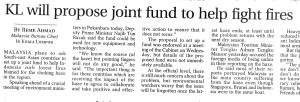 Malaysia’s Deputy Prime Minister Najib Tun Razak has a brilliant idea to solve the haze problem. According to a Straits Times report today, he wants South-east Asian countries to set up a fund to help Indonesia curb forest fires blamed for the choking haze in the region. Speaking ahead of a crucial meeting of environment ministers in Pekanbaru today, he said the fund could be used for new equipment and technology.
“We know the source (of the haze) but pointing fingers will not do any good. The important thing is for these countries which are receiving the impact of the haze to agree to collaborate and take positive and effective action to ensure that it does not recur.”
Now I understand what he meant when he said at the 5th Shangri-la Dialogue, in Singapore, on June 4 2006 that "We need to go beyond words."
Doesn’t the minister know that even money donated for victims of the 2004 Indian Ocean Tsunami disaster have not reached them after 2 years. By the time our money reach the right people to purchase the equipment and technology he spoke about, there may not be any more forests left to burn.
I have a better idea. We should collect all the money in cash, and then burn them in front of Indonesia’s Environment Ministry (if they have one) sometime in June next year; just before the annual forest burning ritual begins. Then when they see the smoke of our precious dollars burning, they will be reminded to do something. This is because, “environmental watchers worry that the issue will be forgotten once the latest haze ends, at least until the problem returns with the next dry season.”
Wednesday, August 09, 2006
Not Good Enough for Singapore
In 1994, the brains in Mindef decided that the name 'reservist' was not suitable for us because it presented a 'psychological barrier' by suggesting that when a soldier completes his full time national service and goes into 'reserve' he is mentally not ready to be called up for action at short notice. Hence, we adopted the new name called ‘Operationally Ready NSmen'. Quite a mouthful isn't it?
I have always considered that line of reasoning a bit silly. If this logic is correct, then Israel, the country that first helped us to start our armed forces is in big trouble. In the past few weeks, they have been calling up their supposedly operationally-not-so-ready reservists to go into battle against the Hezbollah in Lebanon.

A Straits Times article of 8 August 2006
Anyhow, this is not the purpose of my post. I want to blog about the sad situation that Israel finds herself in today. In Singapore, we fathers tell NS stories to our sons. Over there, they tell real battle stories, and show real battle scars - that is if they make it back alive.
We should thank God that we have a good government here who have learned to live peacefully with our neighbours. What if we had some hot-tempered, fighting-cock type prime minister who responded tit-for-tat to the regular taunts of our closest neighbour's former prime minister who never tires of trying to pick a fight with us. Thankfully that megalomaniac has been replaced a gentleman; and a god-fearing one too.
May we never have to go the way of the Israelis.
I have always considered that line of reasoning a bit silly. If this logic is correct, then Israel, the country that first helped us to start our armed forces is in big trouble. In the past few weeks, they have been calling up their supposedly operationally-not-so-ready reservists to go into battle against the Hezbollah in Lebanon.
A Straits Times article of 8 August 2006
Anyhow, this is not the purpose of my post. I want to blog about the sad situation that Israel finds herself in today. In Singapore, we fathers tell NS stories to our sons. Over there, they tell real battle stories, and show real battle scars - that is if they make it back alive.
We should thank God that we have a good government here who have learned to live peacefully with our neighbours. What if we had some hot-tempered, fighting-cock type prime minister who responded tit-for-tat to the regular taunts of our closest neighbour's former prime minister who never tires of trying to pick a fight with us. Thankfully that megalomaniac has been replaced a gentleman; and a god-fearing one too.
May we never have to go the way of the Israelis.
Saturday, May 28, 2005
The Great Singapore Massacre
The Great Singapore Sale just started today. But I wonder how many of my fellow Singaporeans are aware that the Great Singapore Massacre has started long ago.
According to the Singapore Obstetrics and Gynaecology Society, 14,000 abortions were carried out last year. President of the society, Dr Lee Keen Whye was reported to be disappointed that the number of tertiary-educated women going for abortions has tripled in the last 16 years. Doctors say it is shocking that abortion rates among tertiary-educated married women in Singapore are still high, since educated women are supposed to comprehend the importance of family planning. They think that more education on family planning methods is required.
I believe that this will not work because the real issue is not about ignorance but about values.
As long as our society, and that includes men and government leaders, do not believe that a fetus is a living human being that can breathe and feel pain, and that abortion is equivalent to killing, things will not improve. As long as we tell ourselves that, since we cannot see the baby inside a woman’s womb, we cannot hear it crying, then it is not alive and can be disposed of as and when we want, then things will not improve.
Yes, education is required; but it should be education on the real facts of life; for both men and women. I urge all readers of this post to go to the following website and find out the facts for yourself: www.justthefacts.org

If you knew the facts, then you will not be like those readers who wrote to the press after last Tuesday’s news article. Instead of grieving for the loss of precious lives, they bemoan the “waste” of babies because our country is facing a population decline.
If more Singaporeans knew the facts, then maybe in addition to the tears that they shed at the passing of our former president and the pope, they will shed a tear or two for those 14,000 unknown, unnamed babies who died last year. Both Dr Wee and Pope John Paul lived to their eighties; but I wonder how many of the 14,000 lived up to 80 days.
If more Singaporeans knew the facts, then maybe we as a society will feel some shame for the fact that our country has one of the most liberal abortion laws in the world.
I know from my visits to many Singaporean blogsites that most young Singaporeans value life and that’s why they oppose the death penalty. I suggest that they divert some of their sympathy for convicted murderers to innocent babies.
As you enjoy the Great Singapore Sale over the next 40 days, please remember that during that 6-week period, another 1,611 babies would have been killed.
I end with these words from Dr Jerome LeJune, genetics professor at University of Descartes in Paris; and discoverer of the Down’s Syndrome chromosome.
“I have learned from my earliest medical education that human life begins at the point of conception. I submit that human life is present throughout this entire sequence from conception to adulthood and any interruption at any point constitutes a termination of human life.”
Monday, May 16, 2005
If We Decide to Go Ahead
Everytime a minister utter those dreaded words, I fear its more bad news on the doorstep.
For the past one year, during the 'Great Casino Debate", every minister who spoke on the subject used these dreaded words, promising to take care of the people who become addicted to gambling etc. etc. And then they went ahead to announce the decision to build 2 casinos.
Today I heard those dreaded words again. The transport minister promised in parliament that if the transport companies are permitted to raise their bus and mrt fares, the government will make sure that the poor will get help etc. etc.
Looks like its another foregone decision. Afterall the transport companies put up a convincing argument. They have not increased fares for ages - the last fare hike was in practically in the last century, in year 2002. Costs of everything has gone up; and one of them only made a profit of $34 million last year.
I wish I could do that in my business; increase prices because costs have gone up.
For the past one year, during the 'Great Casino Debate", every minister who spoke on the subject used these dreaded words, promising to take care of the people who become addicted to gambling etc. etc. And then they went ahead to announce the decision to build 2 casinos.
Today I heard those dreaded words again. The transport minister promised in parliament that if the transport companies are permitted to raise their bus and mrt fares, the government will make sure that the poor will get help etc. etc.
Looks like its another foregone decision. Afterall the transport companies put up a convincing argument. They have not increased fares for ages - the last fare hike was in practically in the last century, in year 2002. Costs of everything has gone up; and one of them only made a profit of $34 million last year.
I wish I could do that in my business; increase prices because costs have gone up.
Thursday, April 28, 2005
Management Accountability: Difference between Japanese and Singaporeans
One thing I admire about Japanese managers is their sense of responsibilty and ownership.
In yesterday’s report about the train accident in Osaka, we read that the top management of the Japanese railway company immediately submitted their resignations to bear responsibility for the tragedy. In today's BBC News website you can see a picture of the company chairman bowing and apologising to the public.
Some years ago, when a Japanese airliner crashed in Japan, the CEO of the airline also went to the crash site to apologise to the relatives of the casualties. It was reported that he received a mouthful from the grieving relatives.
Sad to say, we do not see this type of sense of responsibility and shame when things go wrong in Singapore. Consider the case of the national serviceman who was literally tortured to death during combat survival training in 2003, or the collision involving the RSS Courageous with the ANL Indonesia in 2003, or the Nicoll Highway collapse last year. In each case, did we see the top management apologize? Were they taken to task? Sadly, no. Only those directly involved were charged and punished.
On the other hand, whenever the top guns at these organizations, such as the ministers and deputy ministers, or permanent secretaries resign or retire, the newspapers will publish a long list of the achievements that took place during their term of office as if they were the ones who deserved all the credit.
And we wonder why Singaporean workers are so “disloyal”? And the HR managers accuse Singapore workers of changing jobs for just a few extra dollars.
In yesterday’s report about the train accident in Osaka, we read that the top management of the Japanese railway company immediately submitted their resignations to bear responsibility for the tragedy. In today's BBC News website you can see a picture of the company chairman bowing and apologising to the public.
Some years ago, when a Japanese airliner crashed in Japan, the CEO of the airline also went to the crash site to apologise to the relatives of the casualties. It was reported that he received a mouthful from the grieving relatives.
Sad to say, we do not see this type of sense of responsibility and shame when things go wrong in Singapore. Consider the case of the national serviceman who was literally tortured to death during combat survival training in 2003, or the collision involving the RSS Courageous with the ANL Indonesia in 2003, or the Nicoll Highway collapse last year. In each case, did we see the top management apologize? Were they taken to task? Sadly, no. Only those directly involved were charged and punished.
On the other hand, whenever the top guns at these organizations, such as the ministers and deputy ministers, or permanent secretaries resign or retire, the newspapers will publish a long list of the achievements that took place during their term of office as if they were the ones who deserved all the credit.
And we wonder why Singaporean workers are so “disloyal”? And the HR managers accuse Singapore workers of changing jobs for just a few extra dollars.
Wednesday, April 27, 2005
The Secret of Effective Government
An old couple who had been married for decades were asked what was their secret to a successful marriage.
The secret is compromise, the old man replied. Whenever my wife and I have a disagreement, we compromise. We will each present our arguments and then we compromise and do it her way.
The Singapore government is widely recognized as one of the most effective governments in the world. Numerous experts and surveys, like Beri have rated our government highly.
And their secret? They listen to the people.
After one full year of listening to ordinary citizens, religious leaders, civic organizations and even parliamentarians, plus an unprecedented petition carrying 30,000 signatures argue against the idea of building a casino in Singapore, they announced last week to build not one but two casinos.
The surprising thing is that nobody was surprised.
Paul Simon was right. After changes upon changes, we are more or less the same.
The secret is compromise, the old man replied. Whenever my wife and I have a disagreement, we compromise. We will each present our arguments and then we compromise and do it her way.
The Singapore government is widely recognized as one of the most effective governments in the world. Numerous experts and surveys, like Beri have rated our government highly.
And their secret? They listen to the people.
After one full year of listening to ordinary citizens, religious leaders, civic organizations and even parliamentarians, plus an unprecedented petition carrying 30,000 signatures argue against the idea of building a casino in Singapore, they announced last week to build not one but two casinos.
The surprising thing is that nobody was surprised.
Paul Simon was right. After changes upon changes, we are more or less the same.
Subscribe to:
Posts (Atom)

