Friday, January 27, 2006

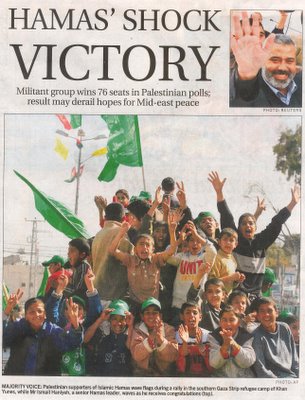
Hamas’ Shock Victory

Two things about this news article which appeared on page 4 of the Straits Times today caught my attention.

“The militant Hamas group, which has called for the destruction of Israel, has swept to a shock victory in the Palestinian elections ……..”


Firstly, I wonder if the significance of this event is lost on the editors of the Straits Times, who chose two local news items about jobs for older workers, and PSA’s bid for P&O, for the front page instead. Don’t they realize that this development is going to impact significantly the state of affairs not only in the Middle East, but also the whole world in the years to come. In contrast, both the BBC and CNN featured this news item prominently on television last night.


Secondly, I noticed that the Hamas supporters in the photo were all kids. In Singapore, I doubt any of them are permitted to watch NC16 movies. That such a large section of the next generation of Palestinians support the ‘manifesto’ of the Hamas group is frightening, don’t you think? I think this is what really qualifies to be labelled 'time bomb'.

“Behold, I will make Jerusalem a cup of trembling unto all the people round about …
And in that day, I will make Jerusalem a burdensome stone for all people:”
- Zechariah 12: 2,3.

Biblical Stand on Death Penalty

I consulted Dr Leong Tien Fock, Research Coordinator with Malaysia Campus Crusade for Christ and this is what he says:


Yes, there is no direct link between Jesus and the question of the death penalty. He did not come to address specific political or legal issues though His life and teaching are relevant to these issues. These issues are already addressed in the Old Testament, which He accepts as authoritative.

Those who oppose the DP claim that Jesus spoke against it in the John 8 incident when He forgave the woman caught in adultery, which was punishable by death under the Mosaic Law. This is probably as close as you can get to linking Jesus with the DP. But there is a world of difference between the DP for MURDER and for any other offences in the OT. DP for murder in the OT (including under the Mosaic Law) was premised on Gen 9:6, which predates the Mosaic Law and was based on an unchanged truth--human beings are made in God's image and are therefore sacred and priceless. DP on other offences (like adultery) stipulated in the Mosaic Law are applications of the 10 commandments that are binding only under the Mosaic Covenant. All we can conclude is that in John 8 Jesus was doing away with the DP on all these other offences. This makes sense as He came to inaugurate the New Covenant to replace the Mosaic Covenant. We cannot use this incident to say Jesus did away with DP for murder because this stipulation predates the Mosaic covenant and was given to Noah and his sons, from whom ALL human beings descended.

Since Jesus accepted the OT as authoritative we can assume that He accepted Gen 9:6 to be authoritative. So we can say Jesus support the DP indirectly by accepting the OT as authoritative and by not repealing it. We can understand why Jesus did not directly address the DP (for murder). It was not an issue in the 1st century! Human conscience (created by God) did not argue against it. People took it for granted and there was no need to talk about it. It is only in the modern world when the theory of evolution began to reshape human conscience that this issue arose. So it has been an issue only very recently (a few hundred years is nothing compared to the entire history of mankind). Even today, most people would support the DP, I think. It is the vocal minority that speak against it.

Let us see how Jesus addressed a legal issue of His day: divorce (Matt 19:3-9). He quotes the book of Genesis (Matt 19:4-6)! So He rests on the authority of Genesis for a legal issue of His day. So if He were to address the DP would He not again quote the relevant passage in Genesis? Note He used Genesis to address the issue of divorce because He was asked to make a stand (Matt 19:3). Nobody asked Him about the DP (on murder)! No one would.

What I have shared here concerns what the Bible teaches on the subject. If people do not accept the Bible as authoritative, the debate will take a very different form. But on a subject like this, unless we assume that God exists and has spoken to us about it, one person's opinion is as good as another's. There is no point debating. If there is no God or He has not revealed moral truths to us, who are we to decide what is right and what is wrong?

The most powerful argument against the death penalty is the existence of wrongful convictions. We must certainly avoid executing the wrong person. But this does not mean the death penalty in itself is wrong. What we need to do is to uphold the death penalty in principle. And have adequately stringent safe-guards to prevent wrongful executions, even if this means some murderers escape the gallows due to the lack of adequately conclusive evidence. At least this will send out the right message that a murderer, if truly convicted, should pay with his own life, upholding the idea that a human life is sacred and priceless. Otherwise people will all the more view a human being as another animal, as taught by the theory of evolution. The consequence of this view is that people are being mistreated.

Why then do many Christians oppose the death penalty for murder? They abhor it. They oppose it based on how they feel towards it, not based on what the Bible says. Some may deny that they oppose it based on feelings. They may claim that it is based on reason, the reason being that a human life is precious, perhaps even going so far to spell out that human beings are made in the image of God. So they are reasoning that the death penalty for murder is wrong because a human life (that of the criminal) is precious. But the Bible is reasoning that the death penalty for murder is right precisely because a human life (that of the victim) is precious, in fact sacred and priceless! A criminal must pay for his crime. What is the just payment for deliberately killing a being made in the image of God? The murderer’s own priceless life.


So unless a Christian claims that his own reasoning is above that of the Word of God or that his own wisdom is higher than that of God, his opposition to the death penalty for murder comes basically from his emotional discomfort towards it. In other words, his God-given conscience conflicts with the God-inspired Scripture. In pre-modern times, the individual as well as the collective conscience of even non-believers agreed with the Bible on the death penalty for murder. If we affirm that the Bible is indeed the standard for our beliefs and behaviour we have to say that the conscience of even Christians have been corrupted.

Paul exhorts Christians to stop being conformed to this world but instead keep on being transformed by the renewing of their mind (Rom 12:2). In the Bible the “mind” is not just the seat of reasoning but also the seat of feeling. Thus to renew our mind is not just about changing what we think about an issue but also how we feel towards it. Whatever the Bible says is wrong, such as greed, but we do not feel it is wrong, our mind needs renewal. Whatever the Bible says is right, such as the death penalty for murder, but we feel it is wrong, our mind needs renewal.


Thursday, January 19, 2006

A Question for those who Oppose the Death Penalty

I followed with interest the ongoing discussion at Mr Wang Says So about the death penalty.

As with many of the previous debates, those who oppose the death penalty (for murder) cite reasons relating to revenge, deterrence and so on. Strangely, they seldom talk about justice. To all these people, I have a question:

What will you say to Mdm Kittiduangrat Ketkanok?

In case you don’t remember, she is the mother of 4-year old Sindee Neo, the girl who was reportedly pushed or thrown to her death from the sixth floor of a HDB flat in Telok Blangah Crescent on October 7, 2004..

I quote from the Straits Times report of 5th August 2005.

Weeping uncontrollably, she said through a Thai interpreter: “I bear no grudge. I only ask for justice for my daughter’s death.”


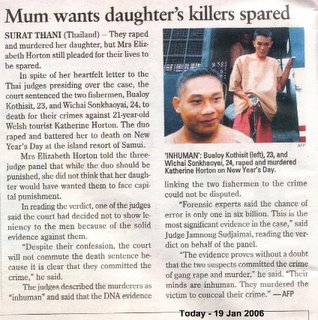
The heart of the issue is justice. It’s not about revenge. Referring to the case of the murder trial in Thailand (see below), even if Katherine Horton's mother is willing to forgive the 2 accused murders, the judges still have to do their job and uphold the law and make the murderers pay for their crime.


It’s is also not about deterrence. Many people quote studies to show that the death penalty is not effective in deterring others from committing murder. But of course, there are also many others, including myself, who question the reliability of such studies. Anyway, my view is that, even if capital punishment is not effective in deterring criminals from committing murders, it is still justified.

I think the Chinese idiom sums it up best: 杀人偿命,欠债还钱。

Mr Wang says that he knows of no religion that is proactively for the death penalty. That’s strange, because I thought 2 of the major religions, namely Islam and Christianity clearly support the death penalty.

Genesis chapter 9, verse 6 (in the Old Testament) clearly specifies the death penalty for the crime of murder. “Whoso sheddeth man’s blood, by man shall his blood be shed: for in the image of God made he man.”

Of course there are also Christians who believe that capital punishment does not apply to the New Testament and church age. But I think I leave it to the theologians to debate that one.


My Related Posts:

Biblical Stand on Death Penalty
Majority of Singaporeans Support Death Penalty
One Country Two Systems
Do Australians Really Oppose The Death Penalty?


Thursday, January 12, 2006

The Great Indian Massacre

Last year I posted an article about the The Great Singapore Massacre

How sad to read of another massacre of far greater proportions recently.
(BBC NEWS : India Loses 10m Female Births)


"More than 10m female births in India may have been lost to abortion and sex selection in the past 20 years, according to medical research.

Researchers in India and Canada for the Lancet journal said prenatal selection and selective abortion was causing the loss of 500,000 girls a year.


Their research was based on a national survey of 1.1m households in 1998.

........"

The irony is that, due to their religious beliefs, many of these people literally will not even kill a fly.

Sunday, January 01, 2006

Sunday Times, 01 January 2005

Two interesting items caught my eye this morning.

Article no. 1: What if you had one year left to live? by Ms Sumiko Tan

Ms Tans thinks that we should focus our minds and prioritize our goals by asking what if we have only 1 year, or 1 month or even just 1 hour to live. She listed 4 things which were her top priority if she had only 1 hour live. Her list included making peace with those she had offended; by sadly she left out making peace with her creator.


“Remember now thy Creator in the days of thy youth, while the evil days come not, nor the years draw nigh, when thou shalt say, I have no pleasure in them.” (Ecclesiastes 12:1)


Article no. 2: Dr N Varaprasad shared his enjoyment in reading the bestseller, The Da Vinci Code

Apparently, he read the book twice, and both times he couldn’t put it down. In contrast I tried to read this book a few months ago. My nephew had recommended it, and week after week, it was the most popular book in our book stores. My reaction though was completely different from that of the learned chief executive of the National Library Board. After a few chapters, I simply could not continue. The blasphemies were too much for me to endure.

The Da Vinci Code has undoubtedly made Mr Dan Brown a very rich man. But the person he blasphemed said these words; “What is a man profited, if he shall gain the whole world, and lose his own soul?” (Matthew 16:26)

Saturday, November 26, 2005

Australian Leaders No Better Than Habibie

Every Singaporean remembers former Indonesian president Habibie’s famous insult when he referred to Singapore as a ‘little red dot’.

“You are nothing, we don’t give a damn about you and we don’t need you as a friend” – is in fact what he was saying.

Now of course the Australian leaders are much more civilized than that. They repeatedly talked about how much they value Singapore’s friendship. But as the saying goes, “Actions speak louder than words”. Australian leaders’ actions in recently demonstrate that they are no better than Habibie.

Take the Michael McCrea incident for example. Remember this guy? He was suspected of murdering his driver, Kho Nai Guan, and the driver's girlfriend, Lan Ya Ming in 2002. He escaped to Britain and then to Australia where he confessed to the crime. Because the Australians do not believe in the death penalty, they refused to extradite him to Singapore. In the end, we had to give the Australians an assurance that he would not be executed even if he was found guilty before they would release him to Singapore.

As a Singaporean, aren’t you outraged by such an arrogant attitude. The crime was committed here in Singapore. Shouldn’t our laws take precedence? By insisting that we give in to their demands, doesn’t it undermine our own laws. Future murderers will simply run and hide in Australia. No, we don’t care. This is our policy. We cannot change for a little red like you.

Now we have the Nguyen Tuong Van incident. This convicted drug trafficker is sentenced to die soon. And the Australian government applies non-stop pressure on us to bend our laws to spare him from the gallows; knowing full well that this goes completely against our stated stand on such matters (Please see excerpt of PM Lee Hsien Loong’s 2004 National Day Rally Speech below).

Don’t you see a double standard being applied when you compare the two cases. You are just a little red dot. We don’t give a damn about your laws. We are civilized people. Your laws are barbaric. You must bend to our demands.

Maybe Dr Mahathir was right after all; “It's very difficult to get along with deputy sheriffs.”


Excerpt of PM Lee’s 2004 National Day Rally Speech

The one thing that will not change is our approach to foreign relations. We seek to be friends with all countries, especially our immediate neighbours and the major powers. We pursue win-win co-operation with all countries which are willing to cooperate with us. But that does not mean that we can always accommodate the views or positions of other countries. When our vital interests are at stake, we must quietly stand our ground. As Dr Habibie said, Singapore is a little red dot. If we don't defend our interests, who will?

This approach has earned us respect internationally, and a network of good relations with many countries around the world.

From time to time we are put to the test. As a small country, we cannot afford to flinch. When Michael Fay was sentenced to caning for vandalism, President Bill Clinton wrote on his behalf, but we could not remit the sentence to cane. People in Asia noted our stand. When Prime Minister Mahathir pressured us to change the Water Agreements, we stood firmly by our legal rights. We gave a full public explanation of the negotiations with Malaysia, and why we were justified in international law and were prepared to go to any international tribunal.


Footnote: Please don’t misunderstand me. This article is about foreign relations. It’s not about the death penalty. Personally, I don’t support the death penalty except for the crime of murder.

“Whoso sheddeth man’s blood, by man shall his blood be shed: for in the image of God made he man.” - Genesis 9:6

Sunday, November 13, 2005

So Many Insomniacs In Singapore

Out of curiousity, I did a Google Blog Search on the name "Sleepless in Singapore". To my surprise, I found so many postings by bloggers who were unable to sleep.

It's a bit worrying. So many bloggers are young people. Many bloggers cannot cannot sleep. Can we then conclude that many young people suffer from insomnia in Spore?

For my case, I don't really know what prompted me to use the name Sleepless in Spore. Insomnia is not a problem for me. Reflecting on it, it does seem to be a rather stupid name. Gives the impression of a handsome Tom Hanks type when if fact it is just the opposite. Actually, at the time when I started this blog, the movie You've Got Mail came to my mind.

Anyway, I will just stick to it. Unlike our government, I am not fond of changing names.

Wednesday, November 02, 2005

Consciously Rude

I once attended a seminar on Safety. The speaker talked about 4 levels of safety behaviour. It goes something like this:
  • Level 1: Unconciously unsafe - this person is not even aware that he is behaving in an unsafe manner.
  • Level 2: Consciously unsafe - this person has probably undergone safety training, and is aware that he is behaving in an unsafe manner.
  • Level 3: Consciously safe - this person has probably undergone safety training too, and consciously reminds himself to adopt safe work practices.
  • Level 4: Unconciously safe - after prolonged practice, safety becomes a part of this person's habits and he adopts safe practices unconsciously (e.g. Sporeans buckling up whenever they get into a car).

I believe we can apply this concept to customer service by replacing the words, 'safe' and 'unsafe' with the words, 'courteous' and 'rude'.

I think many small Singaporean establishments like the HDB retail shops and hawker stalls belong to the Levels 2 and 3. Previously they mostly belonged to Level 1. But the bad economy and tough competition caused them to 'shape up or ship out'.

The other day, I bought some fruits at an HDB shop in North Buona Vista. As the lady started to count the apples that I have selected and pack them into a plastic bag, she suddently put one aside and told me curtly to take another. As my hearing was not so good, I asked her to repeat.

"Go and take another apple", she ordered somewhat impatiently. "This one is bad."

After I returned with a new apple, she toned down her voice considerably to explain that one of the apples I had chosen earlier was slightly rotten. (She was probably thinking. "This chap is not only deaf, he is blind as well.") It wasn't exactly an apology, but she must have realised that she shouldn't have adopted such a rude tone of voice with her customer.

I cannot comment about the situation in expensive establishments because I seldom patronise such places. But, I suspect mostly they are in Level 3. With the strong emphasis on customer service training, many sales staff do make an attempt to be courteous. But it is tough for them because it goes against their nature.

I am sorry to say this; but I think that Singaporeans generally are quite rude and impatient. I hope many people will disagree with me.